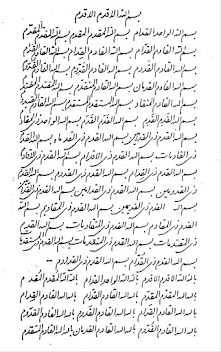
A Bayānī Commentary on Malcolm X’s “I Have a Nightmare”

Brothers and sisters, I'm here to tell you that I charge the White man. I charge the White man with being the greatest murderer on earth. I charge the White man with being the greatest kidnapper on earth. There is no place in this world that that man can go and say he created peace and harmony. Everywhere he's gone he's created havoc. Everywhere he's gone he's created destruction. So I charge him. I charge him with being the greatest kidnapper on this earth. I charge him with being the greatest murderer on this earth. I charge him with being the greatest robber and enslaver on this earth. I charge the White man with being the greatest swine-eater on this earth, the greatest drunkard on this earth.
He can't deny the charges. You can't deny the charges. We're the living proof of those charges. You and I are the proof. You're not an American, you are the victim of America. You didn't have a choice coming over here. He didn't say, "Black man, Black woman, come on over and help me build America." He said, "Nigger, get down in the bottom of that boat and I'm taking you over there to help me build America." Being born here does not make you an American. I'm not an American. You're not an American. You are one of twenty-two million Black people who are the victims of America.
You and I, we've never seen any democracy. We ain't seen no democracy in the cotton fields of Georgia. That wasn't no democracy down there. We didn't see any democracy on the streets of Harlem and the streets of Brooklyn and the streets of Detroit and Chicago. That wasn't democracy down there. No, we've never seen democracy; all we've seen is hypocrisy. We don't see any American dream. We've experienced only the American nightmare ~ Malcolm X
What confronts us here is not a series of unfortunate encounters with individual antagonists, but the encounter with a regime of power that has perfected the art of appearing innocent. Fanon teaches us that colonial domination does not merely operate through violence or law; it operates through the production of reality itself. The colonizer does not only command territory—he commands meaning, legitimacy, and the grammar of the human. In this sense, the white liberal subject does not experience himself as dominant at all. He experiences himself as the measure of the real.
The white liberal order thus encounters non-European juridical or ontological traditions not as interlocutors, but as pathologies. They are immediately framed as excessive, dangerous, irrational, or “absolutist,” not because they are violent, but because they refuse the colonizer’s arbitration. This is precisely what Fanon identifies as the moment of epistemic violence: the colonized subject is not refuted, but reclassified. His law becomes fanaticism, his metaphysics becomes delusion, his refusal to translate becomes proof of unfitness. The violence here is not physical; it is ontological. It is the violence of being told that one’s mode of existence is unintelligible unless it passes through the colonizer’s reason.
In this schema, the white liberal man appears not as a brute, but as a civilizing agent. He does not say “I dominate you”; he says “I am worried about you.” He does not say “I will destroy your tradition”; he says “I will reinterpret it for your own good.” He does not say “submit”; he says “be reasonable.” This is the genius of liberal colonialism: domination without confession. Fanon already warned us that this form of power is more insidious than overt brutality, because it recruits the language of care, progress, and universality to conceal its coercive core.
What is denied at every stage is the reality of race and power. The white liberal subject insists that he is merely defending reason, democracy, secularism, or pluralism. But this insistence is itself the symptom. As Fanon makes clear, the colonizer’s greatest anxiety is not rebellion, but opacity—the refusal of the colonized to render himself transparent to colonial understanding. The non-assimilable tradition terrifies precisely because it cannot be fully translated, moderated, or absorbed without remainder. It stands as a limit to liberal sovereignty.
The result is a familiar cycle. First comes denunciation: the tradition is declared dangerous. Then reinterpretation: it is stripped of its juridical force and reframed as symbolic, ethical, or merely cultural. Finally, capture: intermediaries—often liberal, progressive, or “spiritual” figures adjacent to power—are deployed to tame, sanitize, and render the tradition safe for incorporation. Throughout, the colonizer insists that nothing political or racial is occurring. This is simply reason doing its work.
But Fanon is unequivocal: this denial is the very mechanism of domination. The white liberal order does not merely govern bodies; it governs horizons of possibility. It decides which worlds may exist and which must be reduced to curiosities, threats, or errors. Those subjected to this order are then accused of hostility, extremism, or ingratitude when they refuse assimilation. In truth, they are refusing erasure.
In this light, the contemporary liberal subject who attacks, disciplines, or “critiques” from a position of unmarked authority is not an aberration. He is the heir of a long tradition of colonial reason. He may not carry a whip or a gun, but he carries something more enduring: the presumption that he speaks from nowhere, for everyone, and against no one in particular. Fanon teaches us to name this presumption for what it is—not neutrality, but power masquerading as universality.
Now, if Martin Luther King Jr.’s “I Have a Dream” names the liberal promise at its most generous—formal equality, civic inclusion, recognition under law—then “I Have a Nightmare” names the truth that liberalism cannot acknowledge: that the very economic order underwriting liberal freedom continuously manufactures racial hierarchy as a condition of its own operation. The nightmare is not the failure of liberalism to live up to its ideals; it is that liberalism, once historically realized as capitalism, requires inequality, disposability, and racial differentiation in order to function at all. Capitalism is not a betrayal of liberalism. It is its fulfillment.
From this vantage, racism is not an accidental prejudice that capitalism might someday outgrow. It is a structural necessity. Capital requires differential valuation of bodies, lands, and lives; it requires zones of extraction and zones of protection; it requires populations rendered cheap, fungible, and expendable. The racialized subject is not a moral aberration but an economic product. As Fanon saw with terrifying clarity, the colonial world is divided not merely by ideology but by ontology: some are made into bearers of value, others into resources. Liberalism may preach universality, but capitalism operationalizes hierarchy—and race is its most efficient technology.
This is where the Bayān intervenes, not as ethics, not as metaphor, but as juridical sabotage. The ordinance of the 9th Gate of the Eleventh Unity of the Bayān forbidding the buying and selling of the Four Elements—earth, water, air, and fire—constitutes a direct assault on the metaphysical foundation of capitalist modernity. Capitalism presupposes that the elements of existence themselves may be abstracted, owned, priced, and exchanged. Land becomes real estate, water becomes commodity, air becomes carbon credit, fire becomes energy futures. The Bayān declares this entire grammar illicit. It does not seek regulation or reform; it names alienability itself as a metaphysical crime.
In doing so, the Bayān strikes simultaneously at base and superstructure. At the level of the base, it abolishes the possibility of accumulation by denying capital its raw materials as commodities. At the level of the superstructure, it dismantles the ideological fiction that markets are neutral, natural, or race-blind. For once the elements are removed from exchange, the racial logic that governs their extraction is exposed as unjustifiable. You cannot commodify land without first rendering its inhabitants disposable. You cannot sell water without deciding whose thirst matters. You cannot trade air without calculating whose lungs are worth protecting. The Bayān collapses these calculations by refusing their premise.
This is why the Bayān cannot be assimilated into liberal pluralism. Liberalism can tolerate critique, symbolism, even dissent—but it cannot tolerate a law that abolishes its economic ontology. The prohibition on buying and selling the Four Elements is not a spiritual flourish; it is an anti-capitalist ordinance of the highest order. It renders impossible the very processes through which liberal societies produce racialized subjects while denying that race is operative at all. In this sense, the Bayān does what liberalism never could: it attacks racism not at the level of attitudes, but at the level of economic being.
Thus the nightmare: a world that speaks endlessly of tolerance while perfecting extraction; that denounces racism while reproducing it daily through markets; that celebrates freedom while pricing the conditions of life itself. Against this nightmare, the Bayān does not offer a dream of inclusion. It offers rupture. It does not ask to be recognized by the liberal order; it declares that order metaphysically void. And it is precisely this—far more than any doctrinal claim—that provokes hostility, denunciation, and attempts at capture. For a capitalism that must racialize in order to survive cannot tolerate a law that makes the world itself inalienable.
Liberal Pluralism, Capital, and the Fiction of Tolerance (Polanyi)
That said, liberal pluralism is not a neutral ethic of tolerance; it is a market logic masquerading as moral virtue. What liberalism calls “pluralism” is in fact the regulated circulation of difference within parameters set by capital. Beliefs, identities, cultures, and even forms of dissent are tolerated only insofar as they remain exchangeable, non-sovereign, and non-obstructive to accumulation. Difference is welcomed as long as it behaves like a commodity: portable, aestheticized, decontextualized, and ultimately disposable. Pluralism, in this sense, is not the recognition of irreducible otherness, but its conversion into consumable variety.
This is why liberal pluralism recoils not from violence or hatred as such, but from non-marketable forms of difference. Traditions that can be translated into lifestyle choices, symbolic ethics, or private spirituality are embraced; those that assert juridical force, ontological priority, or limits on exchange are immediately pathologized. The question liberalism asks is never “Is this true?” or even “Is this just?” but “Can this be managed, moderated, or monetized?” Where the answer is no, pluralism ends and coercion begins—usually under the sign of reasonableness, safety, or public order.
Capital is therefore the hidden legislator of liberal tolerance. It determines in advance which differences may coexist and which must be neutralized. This is why liberal societies can celebrate diversity while intensifying racial inequality, why they can host endless dialogue while foreclosing structural change, and why they can tolerate radical aesthetics while suppressing radical law. As soon as a tradition threatens the commodification of land, labor, life, or meaning—as the Bayān does through its prohibition on the buying and selling of the Four Elements—it exceeds the bounds of permissible plurality. It cannot be pluralized because it cannot be priced.
Seen this way, liberal pluralism is not the opposite of domination but one of its most refined techniques. It replaces overt exclusion with conditional inclusion, open repression with managed visibility. It does not say “you may not exist,” but “you may exist only in forms compatible with circulation.” Against this, any tradition that insists on inalienability—of land, of life, of law, of truth—appears not merely intolerant, but unintelligible. And it is precisely this unintelligibility that exposes liberal pluralism for what it is: not an ethic of coexistence, but the cultural superstructure of capital itself.
Now, Karl Polanyi’s central insight in The Great Transformation (1994) is that modern capitalism rests on a foundational lie: the treatment of land, labor, and money as commodities, when in fact none of them are produced for sale. They are what Polanyi famously calls fictitious commodities. Land is the earth itself, labor is human life-activity, and money is a social relation. To subject these to market logic is not merely inefficient or unjust—it is civilizationally catastrophic. Society, Polanyi argues, is then forced into a perpetual “double movement”: market expansion on the one hand, social protection on the other, with mounting violence when protection fails.
Liberal pluralism emerges historically as the cultural and ethical supplement to this commodifying regime. It promises tolerance, diversity, and coexistence—but only after land, labor, and life have already been abstracted into exchangeable units. What liberalism tolerates is not difference as such, but difference after the material world has been rendered alienable. Pluralism thus follows the logic of capital, not the logic of justice. It can celebrate cultural multiplicity precisely because the elemental conditions of existence have already been priced, owned, and governed by market sovereignty.
This is why liberal pluralism is perfectly compatible with racial domination. Once land is a commodity, those tied to land can be dispossessed. Once labor is a commodity, bodies can be ranked, priced, and exhausted. Once money becomes the universal mediator, human worth becomes legible only through productivity and consumption. Race enters here not as a moral error but as an economic technology: a way of differentially valuing laboring bodies and expropriated lands. Capitalism does not accidentally produce racism; it requires it.
“I Have a Nightmare”: Malcolm X as Political Economist
Read in this light, Malcolm X’s “I have a nightmare” is not a racial rant but an indictment of a political economy. When he says “I charge the white man,” the charge is not against pigmentation but against a historical formation: a world-devouring system that commodified land, kidnapped labor, and monetized life on a planetary scale. His catalogue—murder, kidnapping, robbery, enslavement—is not metaphorical. It is the literal history of capitalist expansion. Malcolm’s insistence that Black Americans are “victims of America” rather than participants in its democracy is a direct refusal of liberal pluralist mythology. Democracy, he observes, never existed where labor was coerced, land was stolen, and bodies were owned. What was offered instead was inclusion after the fact: civil rights without economic sovereignty, recognition without restitution, pluralism without decommodification. The nightmare, then, is not hypocrisy alone—it is the structural impossibility of democracy within a system that commodifies the conditions of life itself.
This is where the Bayān enters with devastating clarity. Its ordinance prohibiting the buying and selling of the Four Elements—earth, water, air, and fire—is not a mystical flourish or symbolic ethic. As we said, it is a juridical negation of the very foundation Polanyi identifies as destructive. The Bayān abolishes fictitious commodities at their root. It declares that the elements of existence are inalienable, not subject to exchange, ownership, or price. In Bayānī terms, capitalism is not merely unjust; it is metaphysically illegitimate. To sell land is to deny its divine trusteeship. To sell water is to deny its universal right. To sell air is to deny shared breath. To sell fire—energy—is to deny the common power of transformation. By removing the elements from the market, the Bayān collapses the economic basis on which racial hierarchy is built. If land cannot be owned, it cannot be stolen. If labor is not commodified, bodies cannot be priced. If life is not exchangeable, populations cannot be rendered disposable. Hence why the Bayān functions as a weapon against both base and superstructure. Economically, it forecloses accumulation. Ideologically, it exposes liberal pluralism as a management strategy for commodified difference. The Bayān does not ask to be included in the liberal order; it declares that order void at the level of being.
Seen through this lens, Malcolm X’s charge is not racial essentialism but ontological accusation. The “white man” names a system that universalized itself while denying universality to others; that preached freedom while commodifying life; that spoke of democracy while organizing extraction. The Bayān does not answer this charge with counter-rhetoric. It answers it with law: you may not buy or sell the world. Where liberalism responds to the nightmare with dreams of better inclusion, the Bayān responds with rupture. It refuses the marketization of the elements that made the nightmare possible in the first place. And in doing so, it reveals the deepest truth beneath Malcolm X’s fury: that peace, harmony, and democracy cannot exist where the conditions of life are for sale. That is not hatred. It is judgment. It is Truth.