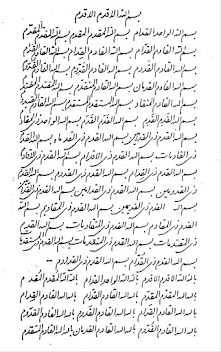
A Note on Rousseau and the Bayān: A Dialogue on Property, Law, and the Origin of Inequality

Jean-Jacques Rousseau (d. 1778) begins the Discourse on the Origin of Inequality (1755) with a scene that still unsettles modern political thought. He opens with this famous scene:
The first man who, having enclosed a piece of ground, bethought himself of saying “This is mine,” and found people simple enough to believe him, was the true founder of civil society.
With that gesture, Rousseau tells us, society is born—and with it inequality,
domination, and moral corruption spanning the entire human experience. This is
not an incidental remark. It is the conceptual fulcrum of the entire work.
Rousseau knows that the juridical recognition of property, especially land, is
the decisive rupture that transforms natural difference into structural
inequality.
Yet Rousseau never quite follows this insight to its conclusion. He exposes the crime, but he cannot abolish the law that ratifies it. His critique stops at moral denunciation and historical diagnosis. The Bayān does not stop there. It legislates where Rousseau hesitates. Imagine, then, a dialogue not between two men, but between two logics: Rousseau’s liberal-republican critique of inequality and the Bayān’s juridical-ontological prohibition on the buying and selling of the Four Elements.
Rousseau would immediately recognize the Bayān as answering the question he posed but could not resolve. When the Bayān declares that Air, Fire, Water, and earth may not be bought or sold, it strikes directly at the moment Rousseau identifies as the origin of corruption. It prevents enclosure from ever acquiring legal force. It renders the founding lie—“this is mine”—juridically void before it can become socially binding. Where Rousseau imagines a warning cry that history never heard, the Bayān makes the warning into law. But this is precisely where Rousseau would recoil.
For Rousseau, legitimate law must arise from the general will. Even when he condemns property as the source of inequality, he still assumes that law is ultimately a product of human convention and collective consent. The Bayān violates this assumption. It does not ask whether the people agree to the inalienability of the elements. It does not negotiate with appetite, habit, or interest. It establishes a limit on contract itself. Certain things are placed beyond exchange not because society has chosen so, but because exchange itself is declared illegitimate at that level of being.
Rousseau would object that such a law risks tyranny. How can freedom survive if limits are imposed prior to consent? How can legitimacy exist without deliberation? These are sincere questions within Rousseau’s framework. But they also reveal the boundary he cannot cross. Rousseau remains committed to a political ontology in which everything, including the earth, is ultimately negotiable through the social contract. The Bayān rejects that ontology outright. It asserts that there are domains where consent cannot authorize alienation without destroying the very conditions of human life and equality. This is the decisive philosophical divergence. Rousseau believes inequality arises because humans mistakenly consented to property. The Bayān understands inequality as arising because property was ever permitted to become a juridical possibility in the first place. Rousseau hopes for a virtuous republic that restrains excess after the fact. The Bayān precludes the excess by foreclosing its legal ground.
From this perspective, the Bayān resolves the conundrum that haunts Rousseau’s opening pages. Rousseau knows that once land is enclosed, no amount of moral exhortation can undo the damage. Civil society is born already corrupted. The Bayān refuses to allow that birth to occur. It does not attempt to repair inequality downstream; it damns its source. So if Rousseau were forced to confront this resolution honestly, he would have to admit that his critique remains incomplete. He diagnoses inequality with unparalleled clarity, yet remains bound to a liberal horizon in which property must be reformed rather than abolished at the ontological level. The Bayān completes his insight by abandoning that horizon altogether. It does not seek a better social contract; it declares certain contracts null and void at the outset.
This is why the Bayān remains unintelligible, even threatening, to modern liberal thought. Liberalism—of which Rousseau is a foundational critic and contributor—cannot accept inalienability without consent. Capitalism, as liberalism’s highest stage, cannot tolerate limits on exchange that are not justified in market or procedural terms. The Bayān’s ordinance against buying and selling the Four Elements therefore appears not merely radical, but irrational, authoritarian, or dangerous. Yet from Rousseau’s own starting point, it is the only coherent answer.
If inequality begins when the earth becomes property, then equality can only exist where the earth is not for sale. Rousseau sees the wound; the Bayān closes it. Rousseau remains the great diagnostician of modern domination. The Bayān is its surgeon. The tragedy of modernity is not that Rousseau was wrong, but that his insight was never allowed to become law. The Bayān shows what such a law would look like—and why the world built on enclosure recoils from it with such violence and so why the “liberal white man” (let alone his conservative or libertarian brothers) is its greatest enemy.
Bahāʾuʾllāh’s About Face
The contrast between the Bayān’s prohibition on the buying and selling of the Four Elements and Bahāʾuʾllāh’s affirmation of private property in the Kitāb-i-Aqdas marks not a minor juridical divergence but a civilizational rupture. Where the Bayān locates injustice at the level of ontology—treating the commodification of earth, water, air, and fire as the primordial crime—Bahāʾuʾllāh’s legal framework accepts private property as a legitimate and morally regulable institution. This acceptance immediately situates the Aqdas within a world already shaped by market relations, rather than against them.
In the Aqdas, private property is not merely tolerated but sanctified through regulation: inheritance laws, penalties for theft, and protections for ownership presume the legitimacy of alienable goods, land, and wealth. Inequality is addressed ethically—through exhortations to justice, charity, moderation, and obedience—rather than structurally. The problem is no longer that the world has been rendered sellable, but that individuals might misuse what they own. In this sense, the Aqdas mirrors a familiar pattern in post-Enlightenment moral economy: property is naturalized, while virtue is tasked with mitigating its excesses. Capital is not questioned at its root; it is moralized.
From a Bayānī perspective, this is not a neutral shift but a negation. The Bayān does not view inequality as a consequence of moral failure within an otherwise legitimate property regime; it understands inequality as the inevitable product of allowing the elements themselves to enter circulation. Once land can be owned, water priced, air enclosed, and fire industrialized, no amount of ethical instruction can prevent domination from reasserting itself. The Bayān therefore refuses the entire framework within which “ethical capitalism” becomes thinkable. It does not seek kinder proprietors; it abolishes proprietorship at the elemental level.
This difference has far-reaching implications. Bahāʾuʾllāh’s affirmation of private property makes possible a theology that can coexist comfortably with capitalist modernity, colonial administration, and liberal legal orders. It allows the faith to be translated into a universalist ethic compatible with market society, state sovereignty, and gradual reform. The Bayān, by contrast, cannot be so translated. Its law is not reformist but preclusive. It renders illegitimate the very mechanisms—enclosure, extraction, accumulation—upon which capitalist civilization depends. For this reason, the Bayān appears ungovernable, excessive, and dangerous to later systems seeking accommodation with global power.
Seen in this light, the divergence between the Bayān and the Aqdas is not simply theological succession but counter-revolution. Where the Bayān articulates a juridical ontology hostile to exchange as such, the Aqdas reconciles revelation with a world already organized by property and capital. The former announces a break with the logic of civilization as it has come to be; the latter institutes a religion that can survive—and even flourish—within it. That this reconciliation requires the abandonment of the Bayānī prohibition on elemental commodification is not accidental. It is the price of admission into the modern world.
This is why, from a Bayānī standpoint, Bahāʾuʾllāh’s property regime cannot be read as a development or clarification, but only as a reversal. It restores precisely what the Bayān sought to make impossible: a world in which the earth may again be owned, traded, inherited, and exploited—albeit under the supposed sign of divine law. The Bayān names that world as already fallen. The Aqdas accepts it as the field of action. In doing so, it shifts revelation from an act of rupture into an act of accommodation, transforming law from a weapon against domination into a framework for managing it. What the Bayān forecloses as ontologically illicit, the Aqdas re-legitimates as morally governable. This is not continuity but inversion: a movement from prohibition to permission, from inalienability to regulation, and from a cosmology of refusal to a theology of survival within the existing order.
And this is, among other reasons, why Bahāʾism once appealed so strongly to elite and middle-class white Anglo-European audiences while the Bayān did not—because it mirrors their own self-conception within the modern world. Bahāʾism offers a universalist ethic that sanctifies property, moralizes accumulation, and frames global dominance as benevolent stewardship rather than structural extraction. It allows those already positioned advantageously within the capitalist world-system to see themselves as agents of unity, peace, and progress without interrogating the material conditions that make such self-images possible. The Bayān, by contrast, refuses this recognition. By naming the commodification of the elements as ontologically illicit, it exposes the violence beneath civilizational order and denies the moral alibi through which domination is reimagined as humanitarianism. It does not flatter the modern subject; it indicts the world that produced him. To these white privileged Anglo-European elites and bourgeoisie, Bahāʾism reflected back to them a purified image of their own historical role—universal, rational, managerial—while evacuating the question of extraction and enclosure that made that role possible. The Bayān offers no such mirror. It strips modern power of its moral cosmetics and names the global order not as incomplete unity, but as organized dispossession.
Conclusion
Taken together, the comparison with Rousseau and the contrast with the Kitāb-i-Aqdas clarify what is truly at issue in the Bayān’s ordinance against the buying and selling of the Four Elements. This ordinance is not an ethical recommendation, a symbolic gesture, or a critique of excess. It is a juridical and ontological refusal of the world that modernity has built. Where Rousseau exposes the moment of enclosure as the origin of inequality but lacks the conceptual means to prevent its repetition, the Bayān intervenes decisively by removing enclosure itself from the domain of lawful possibility. It does not lament the rise of property; it forecloses its elemental foundation. In doing so, it resolves the very paradox Rousseau inaugurates: how inequality becomes structurally inevitable once the earth enters circulation.
The contrast with Bahāʾuʾllāh’s affirmation of private property in the Aqdas further sharpens this point. The Aqdas accepts the world as already constituted by ownership, exchange, and accumulation, and seeks to regulate these forces through moral discipline, legal order, and exhortations to justice. In this framework, inequality is treated as an ethical problem arising from misuse, not as an ontological consequence of commodification itself. The Bayān rejects this premise outright. From a Bayānī standpoint, no amount of moral refinement can redeem a system that permits land, water, air, and fire to be owned, traded, and inherited. To sanctify private property is therefore not a neutral accommodation but a negation of the Bayān’s foundational insight.
What emerges from these two sections is a stark choice between incompatible civilizational logics. Rousseau’s critique remains trapped within liberalism’s horizon, unable to legislate the limits it knows are necessary. The Aqdas reconciles revelation with a capitalist world by accepting property as a given and seeking justice within it. The Bayān alone refuses the grammar shared by both: that the world is fundamentally alienable. Its ordinance against the commodification of the Four Elements is not ancillary to its vision but constitutive of it. It names the point at which liberalism, capitalism, and moralized religion all converge—and draws a line they cannot cross.
This is why the Bayān remains irreducible, unassimilable, and persistently unsettling. It does not offer a better version of modern society, nor a more compassionate capitalism. It announces that the foundational act of that society—the conversion of the world into property—is itself illegitimate. In doing so, it exposes the limits of reformist critique and ethical accommodation alike. Rousseau diagnoses the wound; the Aqdas dresses it; the Bayān cauterizes it. And for a world built on exchange, that act can only appear as an affront.