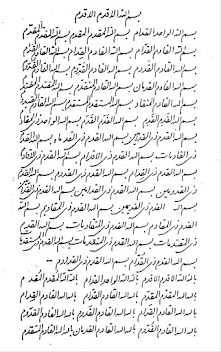
Attempted Liberal Capture of the Bayān: Epistemic Domestication, White {Mis}Innocence, and the Denial of Power

The modern white liberal epistemic order prides itself on openness, pluralism, and tolerance. It claims an unrivaled capacity to include difference without coercion and to adjudicate conflicts through reason rather than force. Yet again and again, when this order encounters traditions that are not merely culturally different but juridically and ontologically non-assimilable, its professed openness collapses into a patterned response: denunciation, reinterpretation, and attempted capture.
Here I argue that such responses are not accidental, nor are they reducible to individual bad faith or misunderstanding. They are structural reactions of liberal modernity when confronted with traditions that refuse its foundational premises. The Bayān—understood not as a cultural artifact or symbolic theology but as a law-constituting, world-negating, ontological rupture—functions as a particularly acute stress test for liberalism. It exposes the limits of liberal pluralism, the racialized nature of its epistemic authority, and the mechanisms by which it neutralizes what it cannot absorb.
Liberalism presents itself as anti-sovereign. It claims to have displaced metaphysical absolutes with procedures, hierarchies with neutrality, and authority with consensus. But as Carl Schmitt, Max Weber, and later Michel Foucault each demonstrated in different registers, liberalism does not abolish sovereignty—it relocates it. In the liberal order, sovereignty resides not in a monarch or a sacred law, but in procedural legitimacy, expert discourse, institutional reasonableness, and epistemic gatekeeping.
The liberal subject is permitted to believe almost anything so long as those beliefs do not claim jurisdiction over reality itself. What liberalism cannot tolerate is not belief, but law—especially law that does not derive from the state, the social contract, or consensual reason. Thus, the Bayān is intolerable precisely because it does not seek validation from liberal reason. It does not argue its case within the liberal forum. It does not present itself as one worldview among others. It announces a break—a reconstitution of reality, normativity, and obligation that does not wait for permission. This is the point at which liberal tolerance ends.
Denunciation: Pathologizing the Excess; Reinterpretation: Making the Unacceptable Acceptable; Attempted Capture: Progressive Intermediaries and UU-Style Universalism
The first response of the liberal epistemic order to such a tradition is denunciation. This denunciation rarely takes the form of outright theological refutation. Instead, it is framed in terms of extremism, irrationality, psychological disturbance, dangerous absolutism, or latent violence. Crucially, the denunciation is presented as protective—protective of pluralism, safety, democracy, or vulnerable populations. The tradition is not attacked because it is false, but because it is said to be unsafe. Here, Frantz Fanon’s analysis of colonial psychiatry is instructive. The colonized subject is not refuted; he is diagnosed. His claims are not engaged; they are rendered symptomatic. In this phase, the Bayān is framed as something that must be opposed, contained, or warned against—not because of what it says, but because of what it allegedly does to those who encounter it.
Denunciation alone, however, is insufficient. Liberalism does not merely exclude; it domesticates. The second move is reinterpretation. At this stage, the tradition is aestheticized, historicized, psychologized, or symbolically defanged. The Bayān here is re-described as a metaphorical spiritual protest, a historical curiosity, a poetic idiom of resistance, or an early attempt at ethical universalism. Its juridical force is denied. Its ontological claims are translated into therapeutic or cultural language. What was law becomes narrative; what was rupture becomes metaphor. This is not misunderstanding. It is both epistemic violence and the logic of market capitalism—the forced translation of a tradition into categories that neutralize its threat.
The third and most insidious move is attempted capture. Here, liberalism no longer positions itself as an external critic. Instead, it installs intermediaries—often progressive, inclusive, UU-adjacent actors—who claim to speak from within or alongside the tradition while quietly reengineering it. Unitarian Universalism is particularly instructive here. Structurally, UU functions as a universal solvent: every tradition is welcomed on the condition that it abandon exclusivity, juridical force, and metaphysical finality. What remains is a curated spirituality compatible with liberal consensus. Through this mechanism, the Bayān is invited in only if it agrees to renounce its legislative claims, soften its eschatology, and subordinate itself to Western liberal ethical norms. This is capture, not dialogue.
The Denial of Race, Power, and Coloniality
Throughout all three phases—denunciation, reinterpretation, capture—there is a persistent denial that race or power are operative at all. This denial is central. As Charles Mills argues in The Racial Contract (199), white liberalism is defined not by explicit racism, but by an epistemology of ignorance—a structured inability to perceive itself as positioned, racialized, or dominant. The authority to decide what counts as “religion,” “extremism,” “acceptable belief,” or “dangerous absolutism” is exercised overwhelmingly by white liberal actors who nonetheless experience themselves as neutral arbiters. The fact that these attacks and infiltrations disproportionately come from white liberal men is not incidental. It reflects a deeper structure in which hermeneutic sovereignty—the power to interpret, classify, and domesticate—is racially coded as universal reason.
By refusing to recognize itself as a racialized and historically situated order, white liberalism converts its particularity into universality and its dominance into common sense. What appears as reasoned moderation is in fact the enforcement of an unmarked norm, one that renders non-liberal juridical traditions intelligible only insofar as they can be reframed within liberal horizons of meaning. Any remainder—any claim that resists translation—is not debated but managed, sidelined, or pathologized. In this way, liberalism’s self-presentation as post-racial and post-colonial becomes the very mechanism through which racial hierarchy and colonial authority persist, now disguised as epistemic hygiene rather than overt rule.
The Bayān, by refusing this conversion, exposes the fragility of liberal innocence. It does not ask to be recognized as one worldview among others, nor does it submit its claims to liberal arbitration. Instead, it names a different ground of normativity altogether, one that does not derive legitimacy from consensus, procedure, or inclusion. This refusal is what provokes such disproportionate anxiety and hostility, for it threatens to unmask the liberal order’s concealed sovereign function: the power to decide, unilaterally and without acknowledgment, which forms of life may appear as reasonable, which may be tolerated as cultural residue, and which must be neutralized in the name of peace. In confronting the Bayān, liberalism does not encounter extremism; it encounters the limits of its own authority—and responds, predictably, by denying that any authority is being exercised at all.
The Bayān as Limit Case
The Bayān exposes liberalism not because it is reactionary, but because it is non-assimilable. It refuses translation into liberal categories. It refuses domestication. It refuses to surrender its claim to legislate reality. The liberal epistemic order responds as it always does when faced with such refusal: by declaring itself neutral, denying power, and attempting capture through inclusion. What is revealed in this encounter is not any extremism falsely attributed to the Bayān, but the limits of liberal pluralism itself. Liberalism cannot tolerate difference unless it come with a white mask. It cannot tolerate sovereignty unless it is a sovereignty it controls. And it cannot admit that its epistemic intolerance is structured by race, power, and colonial inheritance—because to do so would require it to abandon the fiction of its own innocence, of which it is not.