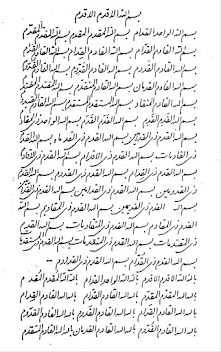
On the function of the Baha'i misrendering of amnaʿ (أمنع)

Amnaʿ (أمنع) is the elative form (afʿal al-tafḍīl) of manʿ (منع). The core semantic field of manʿ is not epistemic concealment but active prevention, barring, warding-off, refusal of access by force or right. Classical lexica (Lisān al-ʿArab, Tāj al-Arūs, Lane) consistently give manīʿ (منيع) as fortified, strongly defended, impregnable; amnaʿ (أمنع) as more so than all others in manʿ—i.e. most able to prevent, most strongly defended, most unassailable. This is a language of fortification and sovereignty, not mere remoteness. Thus, “Most Inaccessible” is a weak rendering. “Inaccessible” instead suggests:
- passive distance
- epistemic difficulty
- remoteness from approach
But amnaʿ (أمنع) implies:
- active resistance
- absolute inviolability
- impossibility of breach, not just approach.
In other words: we are not barred because we cannot reach It; we are barred because nothing can penetrate It. That is a crucial metaphysical distinction. In bismillāh al-amnaʿ al-aqdas (بسم الله الأمنع الأقدس) the pairing matters:
- al-amnaʿ = unbreachable, unassailable, sovereignly closed;
- al-aqdas = utterly purified of all taint, relation, or determination.
If one translates al-amnaʿ as “Most Inaccessible,” and leaves it at that, one collapses it into a quasi-Neoplatonic distance model. But the Primal Point is doing something sharper and far more nuanced. He is saying the Godhead is not merely beyond access—It repels all access categorically. This aligns perfectly with:
- aḥadīya (the Exclusive Oneness) as absolute ipseity;
- the Bayān’s systematic foreclosure of theological penetration;
- the Primal Point’s war on representational theology as represented by the kalām theological models of seminarian orthodox Islamic scholasticism.
Thus, “Most Impregnable” is a far superior rendering because it preserves force, inviolability, defensive sovereignty. Its only weakness probably is that modern English hears “impregnable” almost exclusively in military terms, whereas al-amnaʿ is broader: juridical, ontological, and metaphysical. Still, if forced to choose, the hierarchy is clear:
- Most Inaccessible (passive, epistemic, misleading);
- Most Impregnable (active, inviolable, ontologically consonant).
As such, rendering al-amnaʿ as “Most Inaccessible” domesticates the term, softens its ontological violence, and undermines the Bayān’s radical metaphysics. The Primal Point does not merely say God is far. He says access to God qua the Essence is categorically barred. Given this, rendering it exclusively as “Most Inaccessible” is also not an innocent lexical preference; it is a diagnostic symptom of a metaphysical posture.
When almost every Bahā’ī translator converges on “Most Inaccessible,”what we are seeing is not philology but doctrinal sanitization. “Inaccessible” is safe. It implies distance without exclusion, transcendence without prohibition, mystery without negation. It allows one to say: God is far, but still meaningfully speakable, nameable, administrable. That is precisely the metaphysical space Bahā’ī theology requires in order to preserve a continuous chain of authorized mediation, maintain a surface theology of progressive revelation without ontological rupture, and, most importantly, keep the Godhead conceptually “open” to institutional articulation (which is key here for them). To therefore translate al-amnaʿ as Most Impregnable, as we do, would immediately introduce a problem that cannot be solved within Bahā’ī thinking: If the Godhead is actively unbreachable, then no institutional voice can claim proximity to It—only radical exclusion remains. This would collapse representational theology (which Bahā’ism recreated in its own context), destabilize claims of authorized interpretive succession and, above all, render any attempted administrative metaphysics impossible.
In short: an impregnable Godhead is ungovernable theology and obviates Bahā’ism’s theological domestication, because “Inaccessible” is a term of epistemic modesty whereas “Impregnable” is a term of ontological violence. Bahā’ī translators overwhelmingly choose the former because their pseudo-metaphysical mentality is managerial rather than apophatic, conciliatory rather than catastrophic, and, most importantly, system-preserving rather than abyss-facing. As such, “Inaccessible” is possible in language due to the straitjacketed Bahā’ī concept of the “Covenant” whereas the Bayān shatters that entire epistemic posture altogether from the very beginning. By contrast, the Bayān is destructive in the strict sense: it destroys theological access routes—and specifically postured administrative ones.
The irony is sharp: The very tradition that claims to supersede the Bayān systematically neutralizes its most radical metaphysical terms in translation. What results is a God who is distant but still narratable, exalted but still administrable, transcendent but still institutionally proximate. But that is not the God of bismillāh al-amnaʿ al-aqdas (بسم الله الأمنع الأقدس). Instead, what it reveals about the underlying Bahā’ī mentality (which is a quintessentially European colonial one) is fear of ontological negation, allergy to apophatic extremity, a preference for distance over refusal (which is a bureaucratic frame of mind), and a theology that cannot survive a truly barred Godhead. Our rendering thus restores the knife-edge of the term. And once that edge is restored, the entire metaphysical economy behind the Bahā’ī rendering of al-amnaʿ as “Most Inaccessible” is exposed for what it is: translation as ideological containment, and thus a colonial imposition through language.
What has occurred at the hands of the Bahā’īs is thus hermeneutical violence—and that is precisely why it is so pervasive and often difficult to contest. Once a tradition controls the translation, it controls the conditions of intelligibility. By the time doctrine appears, the work has already been done. In the case of the Bayān, the pattern is consistent:
- Apophatic extremity is softened into reverential vagueness;
- Ontological negation is reframed as epistemic humility;
- Active exclusion (manʿ) is rendered as passive distance (“inaccessible”);
- Catastrophic rupture is rewritten as smooth succession.
This is not accidental. It is systematic domestication at the lexical level.
Texts like the Bayān are dangerous precisely because they operate prior to doctrine (and especially the domesticated, colonially-captured doctrine the Bahā’īs deliberately disfigured the Bayān by)—at the level of naming, grammar, and metaphysical orientation. If al-amnaʿ is allowed to mean Most Impregnable, mediation (and particularly administrative mediation) collapses, authority loses ontological grounding and the manufactured succession proposed by the Bahā’īs becomes metaphysically incoherent. So they neutralized the word right when their theology begins. That is why the struggle is visible at the very level of language.
What makes this especially insidious is that such renderings are presented as “standard,” “reverent,” “clear” and “natural English.” But preference is never neutral when it is structurally aligned with institutional survival (the fundamental Bahā’ī obsession). Choosing Most Inaccessible over Most Impregnable is therefore not a stylistic choice; it is a metaphysical decision. One of the reasons for this is because traditions that cannot metabolize apophatic absolutism convert it into transcendental etiquette. They do not deny transcendence; they attempt to tame it. The Bayān, however, does not permit taming. Its Godhead does not withdraw politely, does not invite reverent speculation, and does not tolerate a sanitized conceptual approach. It bars.
Once this is seen, the cumulative effect becomes undeniable as to what the Bahā’īs have done:
- lexical softening;
- semantic narrowing;
- grammatical smoothing;
- metaphysical reorientation.