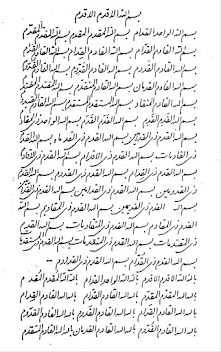
The Four Elements and the End of Political Economy: The Bayān versus Marxism

Do not buy or sell the Four Elements ~ 11th Gate of the Ninth Unity.
لا تبيعون عناصر الرُّباع ولا تشترونها
The quintessence of this Gate is this: that God, the Knower—exalted be Its Name—from the infinite grace of Its endless Being, created the fourfold elements (ʿanāṣir-i rubāʿ) for the sake of Its creation, and rendered them lawful; yet in the Bayān He forbade (nahy farmūda) their buying and selling…
As for earth (khāk), which is the lowest rank of the elements and pure annihilation beneath your feet, He forbade its buying and selling. Likewise, He caused water (āb) to flow for the sake of the elevation and inviolability of your selves, and as the cause of manifest life in your bodies; and every thing in the world is nurtured into existence within the domain of being by means of it. He therefore sought that it be administered by you without price (min dūn-i bahā), and that it not enter into buying and selling. For how grievous it is that the substance of the life of creation should be outwardly sold for dinars, and that a base creature should derive enjoyment from it.
Likewise fire (ātash), and the other element, air (hawāʾ)...Yet since the other three elements have entered into buying and selling, the element of air too is reckoned among their indivisible part (juzʾ-i lā-yatajazzā). And outwardly, the beholding of the breath (dīdan-i nafas) and that which causes the blowing of the wind—indeed, some people exchange the seeing of their own breaths for a wage. He therefore sought that people expend their breaths in the path of God. And whenever they go to the bedside of the sick to recite and to breathe, they should not assign a wage for themselves.
And whenever it is said outwardly that these elements—among them earth and water—are made available without price, yet that they are not carried without recompense, or that one takes payment for water and earth: in such a case, a wage is assigned for the bringer and the remover, so that it be without price—that is, not that the earth is sold for that sum, nor the water; rather, for the sake of the labor of the water-carrier and the bringer of earth, a wage is assigned to them. Likewise fire: whenever there is need of it on ships, some do not give it freely without price…
How many souls have taken large sums as the wage for a single breath, and have set the wage for recitation and breathing as outward dinars; and have sold water, in certain times and places, for what prices—while God, exalted be It, has placed these seas of water, rivers, valleys, streams, springs, and mountains for the sake of Its creation, so that they might partake of Its infinite mercy and be sustained by limitless effusions…
…Whenever they behold the course of the Will within the Temple of the Volition, and the five attachments related thereunto in the very soul of the Decree/Book; and when they consider that the elements are not sold outwardly and that the rank of air is not visible, it is forbidden that souls—who are the totality of the elements—enter absolutely into buying and selling.
The people of the Bayān must absolutely refrain from this act: they must not buy or sell the human soul. This is the true prohibition in the matter of the elements…
—— Ṣubḥ-i-Azal, mutammim’ul-bayān/The Continuation of the Persian Bayān (my partial trans.)[1]
The Bayān’s prohibition on the buying and selling of the Four Elements—Air, Fire, Water, and Earth—must be understood as a juridical act that precedes political economy altogether. Unlike Marxism, which intervenes at the level of production, labor, and exchange, this ordinance intervenes at the level of being. It does not critique exploitation as unjust; it renders commodification itself ontologically void. What Marx exposes as alienation, the Bayān identifies as metaphysical imposture. This point of view holds capitalism not merely immoral or unequal. Instead, it holds it to be founded on a false claim about what may be owned. Where Marxism interrogates the distribution of value, the Bayān revokes the right to posit value in the first place with respect to the elemental conditions of existence.
This is because Marxism remains bound to a materialist grammar in which nature appears as raw substrate—external to the worker, appropriable through labor, and historically mediated through class struggle. Even its most ecological variants preserve this assumption, imagining a rational or equitable administration of nature rather than questioning the premise of administration itself.[2] The Bayān does something categorically different. It declares the elements to be pre-legal ontic trusts: unownable, unexchangeable, and anterior to every regime of value. Their sale is not exploitation; it is a metaphysical falsehood, a claim upon being that cannot, in truth, exist. This is why the prohibition is absolute rather than reformist. It does not regulate extraction; it annuls the ontology that makes extraction intelligible.
This distinction exposes the limits of classical Marxist revolutionary subjectivity. Marxism produces a historical subject—the proletariat—defined by its relation to production and oriented toward a future liberation deferred through revolutionary time.[3] The Bayān produces no such subject. The subject formed by its ordinance is already positioned outside the grammar of exchange. Liberation is not postponed until after the seizure of the means of production; it is instituted immediately through ontological withdrawal. One does not wait to be free. One stands where freedom has already been declared as law, because the conditions that would bind one—air, water, land, fire—have been removed from the market altogether.
Law itself thus undergoes a fundamental transformation. In Marxist analysis, law is superstructure, an ideological reflection of material relations, destined either to be abolished or temporarily repurposed after revolution. In the Bayān, law is not superstructural but ontic. It names what cannot be. The buying and selling of the elements is not prohibited because it is socially harmful, but because it is unreal—an ontological contradiction masquerading as legality. This is why the ordinance does not seek recognition from existing institutions. It does not argue with them. It renders them conceptually obsolete by exposing the metaphysical lie on which they stand.
This ontological intervention also explains why the Bayān does theoretically require revolutionary violence in the Marxist sense. Marxism must seize the means of production because it accepts the terrain on which production is organized. The Bayān erases that terrain altogether. It does not fight capitalism on its own terms; it withdraws the metaphysical legitimacy that allows those terms to exist. Capitalism is not simply overthrown here; it is invalidated. Its violence is revealed not as historical necessity but as metaphysical usurpation. What remains is not a battlefield, but an exposed void, even if the means of production are to be physically seized at some time.
The racial dimension of this move is decisive. Marxism treats race as historically contingent, instrumental to capital, and ultimately secondary to class—an approach that even Fanon had to rupture from within.[4] The Bayān requires no such supplementation. By prohibiting the commodification of the elements, it directly disables the material infrastructure of racial capitalism: enclosure, plantation logic, extractive colonialism, atmospheric control, water privatization, and land theft. These are not accidental features of capitalism; they are its racialized technologies of world-making. The Bayān does not analyze racism; it prevents its conditions of possibility from forming. Racial capitalism thus becomes not merely unjust, but ontologically illegal. At this point, the contrast with Polanyi, degrowth theory, and eco-socialism becomes unavoidable.[5] Polanyi famously argued that land, labor, and money are “fictitious commodities,”[6] and that society periodically attempts to re-embed markets through protective counter-movements. Yet Polanyi never exits the frame of market society itself. He laments commodification while presupposing its conceptual legitimacy, seeking balance rather than abolition. Degrowth theory, similarly, critiques endless accumulation and advocates reduced consumption, localized economies, and ecological restraint—but it leaves untouched the fundamental premise that nature is a resource to be managed more gently. Eco-socialism improves the ethics of administration without challenging the ontology of administration itself.
The Bayān surpasses all of these by refusing the category of commodity outright. It does not seek to re-embed markets, slow growth, or socialize extraction. It abolishes the very idea that the elemental conditions of life can enter exchange at all. There is no “green” version of selling air, no just form of water markets, no equitable privatization of land. These practices are not excessive; they are false. Where Polanyi hopes society will correct itself, and eco-socialism hopes humanity will mature, the Bayān issues an immediate metaphysical judgement: this shall not exist. This is precisely what the corporate state cannot recognize[7]—or the Bayānic subject—as legitimate. Administrative consciousness is structurally incapable of encountering an ontology that does not seek reform, recognition, or inclusion. The corporate state operates through risk assessment, procedural legitimacy, and managed dissent. It can negotiate demands. It can absorb critique. It can even tolerate radical rhetoric, provided it remains within the grammar of policy, rights, and future reform. What it cannot process is an ontological refusal that invalidates its foundational assumptions.
The Bayānic subject does not request rights to air, water, land, or life. He or she denies the state’s authority to distribute them as metaphysical axiom. He or she does not argue that privatization is harmful; he or she declares it metaphysically impossible. From the perspective of administrative systems, such a subject appears unintelligible, excessive, or dangerous—not because he or she is violent, but because he or she stands outside the coordinates through which legitimacy is calculated. The system cannot classify him or her as stakeholder, complainant, or reformer. He or she does not fit any workflow. He or she represents a category error. In this sense, the Bayān does what neither Marxism nor its ecological descendants can do. Marxism dreams of a redeemed future. Degrowth imagines a gentler present. The Bayān judges now. It does not await historical maturation, cultural enlightenment, or institutional reform. It names, in law, what accords with being and what does not. Capitalism, racial domination, and administrative sovereignty are not defeated through struggle here; they are declared void at the level where they never had the right to arise. What remains, then, is not a program but a verdict. Not a movement but a rupture. Not a critique of the world, but a re-naming of what may exist within it. And this is why the Bayān is not simply post-Marxist, eco-socialist, or degrowth-adjacent. It is something beyond.
The Ontological Contrast
Now, the partial translation of the passage we cited above from Ṣubḥ-i-Azal’s Continuation of the Persian Bayān opens by establishing an ontological asymmetry that Marxism never reaches: the Four Elements are created for the sake of creation, rendered lawful in their use, yet forbidden in their commodification. This distinction is decisive. The Bayān does not oppose use, administration, or mediation; it opposes exchange-value itself at the elemental level. Marx critiques exploitation within exchange; the Bayān revokes exchange as a category where the conditions of existence are concerned. The elements are lawful because life requires them, but their sale is forbidden because sale presupposes alienability—and alienability, here, is metaphysically false. The prohibition is therefore not moralistic but ontological: what sustains being cannot itself be made an object of being-for-sale.
Earth is named first precisely because it is “the lowest rank of the elements and pure annihilation beneath your feet.” This is not a denigration of matter, but a metaphysical placement. Earth is the site of extinction, dissolution, and return; to sell it is to claim ownership over annihilation itself. Marxism treats land as a factor of production whose enclosure produces class relations.[8] The Bayān goes further: land-sale is not merely the origin of exploitation, but a false assertion of mastery over finitude. To sell earth is to pretend that death, decay, and return can be priced. This is why the prohibition is absolute, not historical. No future society may legitimately sell earth, because no society owns annihilation. Water then appears not as “natural resource” but as the substance of manifest life, the medium through which everything “is nurtured into existence within the domain of being.” Marx recognizes water only indirectly, as part of material conditions.[9] The Bayān names water as ontologically prior to all production. It therefore demands that water be administered “without price.” Administration is permitted; commodification is forbidden. This distinction annihilates the capitalist fiction that infrastructure, logistics, or scarcity can convert life itself into a commodity. The horror expressed—“how grievous it is that the substance of the life of creation should be outwardly sold for dinars”—is not sentimental. It is metaphysical outrage: life is being treated as a surface phenomenon, while its ontological depth is ignored. Fire and air extend this logic into subtler domains that Marxism cannot reach at all. Fire is energy, transformation, heat—the basis of industry and motion. Air is breath, invisibility, circulation, life itself. The Bayān’s brilliance is to notice that once the other elements are commodified, air too is drawn into the market, even though it cannot be seen. This is an early diagnosis of what we would now call atmospheric capitalism: the monetization of circulation, respiration, attention, vitality. Marx could analyze the sale of labor-power; the Bayān identifies something deeper and more terrifying—the sale of breath itself. When “some people exchange the seeing of their own breaths for a wage,” the critique is no longer economic but ontological: being has been converted into performance-for-pay.
The instruction that people should “expend their breaths in the path of God” rather than for wages is not pietistic. It is an anti-commodification axiom. Breath is the sign of life’s immediacy; to monetize it is to collapse the distinction between existence and exchange. This is why even acts of healing—recitation, breathing over the sick—are forbidden from becoming wage-labor. Marxism accepts that care work can be remunerated under different relations. The Bayān refuses this entirely at the elemental level: once breath enters the market, the soul is already being priced. The passage then makes a crucial clarification that shows the Bayān is not naïve about labor. Payment may be given for labor—for carrying water, transporting earth, tending fire—but never for the element itself. This distinction annihilates the Marxist confusion between value and labor at the deepest level. Marx locates value in socially necessary labor time.[10] The Bayān says: labor may be compensated, but value may not be posited in what sustains existence itself. The wage belongs to the worker, not to the element. This preserves human dignity while preventing ontological theft. Capitalism collapses this distinction deliberately; Marx critiques the collapse but retains the framework. The Bayān abolishes the framework.
The repeated lament over souls who “have taken large sums as the wage for a single breath” pushes the analysis into explicitly spiritual–ontological territory. This is no longer about water markets or land rents. It is about the conversion of soul-functions into exchangeable services. When recitation, breath, and life-energy are sold as commodities, the soul itself has entered the market. Marxism has no conceptual tools here. It can speak of alienation, but not of ontological prostitution, where the very principle of life is priced. The Bayān sees this clearly and names it without euphemism. The cosmological framing—seas, rivers, valleys, streams, mountains placed for creation to partake of divine mercy—further dislocates classical Marxism. Nature is not “free gift to capital” nor “object of stewardship,” but theophanic generosity. To sell it is not only unjust; it is a blasphemous misrecognition of what it is. Political economy is irrelevant at this level. One is dealing with the structure of manifestation itself.
The climactic turn comes when the text links the invisibility of air and the non-sale of the elements to the prohibition on buying and selling souls. This is the decisive move Marxism cannot make. Souls are declared to be “the totality of the elements.” If the elements cannot be sold, then neither can the soul. Slavery, wage-slavery, human trafficking, and the commodification of life are not social evils to be corrected by history; they are ontological impossibilities that no system may legitimate. This is why the passage concludes with absolute language: “The people of the Bayān must absolutely refrain from this act.” Here the Bayān finally exposes classical Marxism’s limit. Marx critiques the sale of labor-power but still accepts its legal form as historically conditioned.[11] The Bayān declares the sale of the soul—of which labor is only one outward function—forbidden in principle. There is no future society in which this becomes acceptable. There is no dialectical justification. This is not ethics; it is ontology legislated as law. Seen in this light, the Bayān does not merely go beyond Marxism; it renders classical Marxism partial, provisional, and metaphysically incomplete—nay, in some cases even obsolete. Marx diagnoses the sickness of capitalism correctly and precisely. The Bayān, however, revokes the possibility of the sickness altogether by forbidding the ontological error on which it depends: the conversion of the conditions of being—and ultimately of being itself—into commodities.
Bahāʾism’s Counter-Revolution
Now, where the Bayān issues an ontological prohibition, Bahāʾism performs a decisive translation of metaphysical law into moral–administrative ethics. The elemental interdiction in the Bayān is not preserved as an ontic limit that annuls commodification at its root, but is quietly reabsorbed into a framework of ethical stewardship, social harmony, and progressive civilization. The Four Elements cease to function as inalienable conditions of being and are instead subsumed into a developmental narrative in which resources may be administered, priced, regulated, and redistributed so long as this occurs within a universalist moral order.[12] What is lost in this translation is precisely the Bayān’s refusal of exchange itself at the elemental level. This shift corresponds to a deeper metaphysical reorientation. In the Bayān, law speaks prior to history and judges it; in Bahāʾism, law is increasingly framed as instrumental to historical progress. The Bayānic ordinance interrupts political economy by declaring certain relations ontologically impossible. Bahāʾism, by contrast, seeks to humanize political economy through ethical norms—moderation, consultation, justice, trusteeship—without revoking its foundational grammar. Capitalism is not rendered void; it is rendered reformable. The market remains intact, now moralized rather than annulled.
The distinction becomes most visible in the question of the soul. In the Bayān, the prohibition on selling the elements culminates in an absolute interdiction on buying and selling the human soul, because the soul is the totality of the elements. This is not metaphorical language; it is an ontological identity. Bahāʾism decisively breaks this identity. The soul is elevated, spiritualized, and abstracted from material relations, while economic life proceeds according to modern administrative norms. As a result, the sale of labor-power, attention, vitality, and even life itself through bureaucratic and economic mechanisms can persist without appearing as a violation of sacred law, because the soul has been displaced into an interior, post-economic register. This displacement allows Bahāʾism to align comfortably with modern institutional forms: the nation-state, global governance, development economics, technocratic administration. Where the Bayān renders administrative sovereignty ontologically illegitimate by denying the alienability of the elements, Bahāʾism legitimates administration by sacralizing order, unity, and procedural harmony. The elemental world becomes something to be managed wisely rather than something that places absolute limits on management itself. In this sense, Bahāʾism does not confront administrative consciousness; it perfects it.
The result is a religion structurally compatible with the corporate state. Bahāʾism can critique excess, inequality, and injustice, but it cannot name commodification itself as ontological falsehood. Air may be regulated, water priced, land developed, labor exchanged, and souls mobilized for “service,” all without violating the system’s metaphysical assumptions. What the Bayān forbids absolutely, Bahāʾism renders conditional, ethical, and developmental. The rupture becomes a gradient. In short, where the Bayān abolishes political economy at its root by forbidding the sale of being’s conditions, Bahāʾism re-enters political economy with a sanctified conscience. It replaces ontological judgement with moral exhortation, metaphysical prohibition with administrative ethics, and immediate rupture with historical gradualism. This is not a difference of emphasis or tone; it is a difference of metaphysical jurisdiction. The Bayān speaks from the level where capitalism has no language. Bahāʾism speaks fluently within the world capitalism has already made. In doing so, Bahāʾism becomes legible to institutions whose power depends on managing life rather than questioning the right to do so. What it offers is not a limit to sovereignty, but a spiritual grammar through which sovereignty can recognize itself as benevolent while remaining intact.
Conclusion
Seen as a whole, the Bayān’s prohibition on the buying and selling of the Four Elements marks a limit-point beyond which political economy cannot pass. It does not offer an alternative economic system in the structural sense, while it does imagine a purified or ethically regulated market with other ordinances. Yet it abolishes the very intelligibility of markets at the level where existence itself is at stake. Air, fire, water, and earth are not inputs, resources, or commons to be better governed; they are the preconditions of manifestation. To treat them as commodities is not just to mismanage nature, but to misunderstand being. This is why the Bayān’s intervention cannot be assimilated to Marxism, eco-socialism, degrowth, or any reformist ecological paradigm. Instead, they must align with it because those traditions remain trapped within a grammar that presumes administration, mediation, and exchange as unavoidable horizons. The Bayān revokes that presumption altogether.
Marxism requires history to complete what ontology cannot: justice must arrive later, after struggle, seizure, and transformation. The Bayān requires no such deferral in theory. By legislating the unexchangeability of the elements, it institutes freedom immediately, not as an outcome but as a condition. The subject formed here is not mobilized toward a future emancipation; it is already standing outside the relations that would bind it. In its initial step, freedom is not achieved by reorganizing production, but by withdrawing from the metaphysical lie that production owns its conditions. What Marxism understands as alienation, the Bayān identifies as category error.
The consequences of this move are not merely philosophical but civilizational. By invalidating the commodification of the elements, the Bayān disables the infrastructural logic of racial capitalism at its root. Enclosure, extraction, plantation economies, atmospheric control, water markets, and land privatization are revealed not as historical contingencies or policy failures, but as ontologically illicit acts. They are not unjust distributions of value; they are false claims upon what no power may possess. In this sense, the Bayān does not oppose the corporate state as a political enemy. It exposes it as metaphysically incoherent. Administrative sovereignty cannot recognize this exposure because it presupposes the very ontology being denied. This essay therefore closes not with a call to action but with a judgment. The Bayān does not ask to be implemented, negotiated, or recognized. It does not seek inclusion within existing regimes of legality or legitimacy. It declares, in advance of all systems, what may and may not exist as law. Capitalism, racial domination, and administrative governance are not overturned here through struggle; they are rendered void at the level where they first claimed reality. What remains is not a blueprint for another world, but a rupture in the one we inhabit—a naming of the ontological limits that no economy, however rational or humane, may cross. In this sense, the Bayān is not post-Marxist or anti-Marxist. It stands elsewhere entirely, legislating being itself where critique, history, and reform can only follow.
[1] https://bayanic.com/lib/typed/sacred/Point/Persian-Bayan/PersianBayan.pdf (retrieved 23 December 2025).
[2] See John Bellamy Foster Marx’s Ecology: Materialism and Nature, online, https://ia904504.us.archive.org/9/items/526394/John%20Bellamy%20Foster.%20Marx%27s%20Ecology..pdf (retrieved 23 December 2025).
[3] See the Communist Manifesto, online https://www.marxists.org/archive/marx/works/1848/communist-manifesto/ (retrieved 23 December 2025).
[4] See his Black Skin, White Masks and The Wretched of the Earth, online, https://monoskop.org/images/a/a5/Fanon_Frantz_Black_Skin_White_Masks_1986.pdf and
https://dn790007.ca.archive.org/0/items/the-wretched-of-the-earth/The%20Wretched%20Of%20The%20Earth.pdf (retrieved 23 December 2025).
[5] For the current degrowth perspective, see Kohei Saito Slow Down: The Degrowth Manifesto, Translated by Brian Bergstrom (Astra House: New York, 2024).
[6] The Great Transformation: The Political and Economic Insights of Our Time (Beacon Press: Boston, 1944), passim.
[7] For our definition of the corporate state, see our The Wretched of the Corporate State (40-2), online https://catalogue.nla.gov.au/catalog/10197702 (retrieved 23 December 2025).
[8] See especially Capital, volume III, online https://www.marxists.org/archive/marx/works/download/pdf/Capital-Volume-III.pdf (retrieved 23 December 2025).
[9] See Capital, volume I, online, https://www.marxists.org/archive/marx/works/download/pdf/Capital-Volume-I.pdf (retrieved 23 December 2025).
[10] Ibid.
[11] Ibid., esp. chapter 6.
[12] See the Kitāb-i-Aqdas, online https://www.bahai.org/library/authoritative-texts/bahaullah/kitab-i-aqdas/ (retrieved 23 December 2025).