The Myth of the “Failed Messiah”: A Civilizational Double Standard
 |
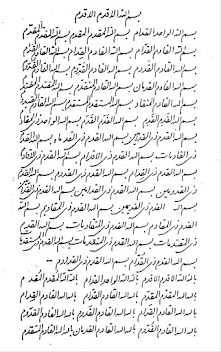
| The Primal Point, the Bāb (d. 1850/returned: 2002). |
The claim that the Bāb represents a “failed messiah” is not a neutral historical judgment. It is a retrospective evaluation grounded in an unspoken criterion: that a messianic figure must achieve immediate worldly success—political consolidation, demographic growth, or institutional permanence—within history in order to be considered valid. This criterion is neither theological nor historical in any rigorous sense; it is sociological, and selectively applied. If this standard is applied consistently, it collapses at once.
By the expectations of Second Temple Judaism, Jesus of Nazareth failed completely. He did not restore Israel, did not overthrow imperial rule, did not inaugurate visible justice, and was executed by the state as a criminal. His followers were scattered, his movement marginal, and his messianic claims—by contemporary Jewish standards—decisively refuted by events. What later “rescued” Jesus from the category of failure was not the outcome of his mission, but centuries of posthumous reinterpretation, delayed eschatology, and eventual imperial adoption. His validation is retrospective and civilizational, not intrinsic to the historical moment of his life. Yet the same generosity is systematically denied to the Primal Point, the Bāb.
When critics label the Bāb a failed messiah, they cite precisely the features that Christianity later reinterpreted as redemptive: rejection, execution, minority status, and the deferral of fulfillment. The difference is not analytical; it is cultural. Jesus is shielded by two millennia of normalization within European civilization. The Bāb, being Iranian, modern, and disruptive of Islamic rather than Roman categories, is denied that hermeneutical patience. Failure is declared early, decisively, and then pathologized. This is because in this biased, politicized perspective the truth of a messianic claim is to be measured by immediate worldly success—political consolidation, demographic expansion, or durable institutional power. This criterion is neither theological nor historically neutral. It is a retrospective sociological judgment masquerading as analysis, and it is applied selectively. When applied consistently, it collapses.
The same logic applies even more forcefully to Ḥusayn ibn ʿAlī (d. 680). By any metric of worldly success, Karbalāʾ represents absolute defeat: military annihilation, abandonment by supporters, the massacre of family, and the failure to dislodge an illegitimate regime. Yet within Shīʿī Islam, Karbalāʾ is not read as failure but as the supreme criterion of truth. Ḥusayn’s “success” lies not in political victory but in ontological exposure—the revelation of false sovereignty through voluntary martyrdom. Defeat becomes authentication; loss becomes eternal triumph. Karbalāʾ inverts the very grammar of success and failure. Any framework that sanctifies Karbalāʾ while dismissing the Bāb as a failure is therefore not applying a coherent theological or historical standard but selectively suspending one. The Bāb stands squarely within this Husaynian paradigm rather than the Constantinian one. His claim is enacted through language rather than arms, through theophany rather than administration, through sacrifice rather than consolidation. Execution, rejection, and minority status are not external refutations of his claim; they are internally legible within Shīʿī metaphysics as signs of its intensity. For example, the Qayyūm al-Asmāʾ (the Commentary on the Sūrah of Joseph) performs authority in the moment of utterance. To judge it by outcomes is to misread its register entirely. The category of “failed messiah” thus reveals itself not as an analytical conclusion but as a biased civilizational reflex: the elevation of power into a criterion of truth after the fact.
Once Jesus, Ḥusayn, and the Bāb are placed side by side, the double standard becomes unavoidable. If execution and apparent defeat invalidate the Bāb, then they must also invalidate the Cross and Karbalāʾ. If the Cross and Karbalāʾ are exempted, then worldly success cannot be the measure of messianic truth. Any attempt to rescue one while pathologizing another exposes not scholarship but bias—specifically, the protection afforded by civilizational familiarity. Jesus is shielded by Christian normalization, Ḥusayn by institutional Islamic sacral memory; the Bāb is denied both. The result is not theology but retrospective power deciding meaning. Thus the choice this analysis forces is stark and inescapable. Either revelation is judged by power, in which case Christianity and Shīʿī Islam collapse along with the Bāb; or power is judged by revelation, in which case the category of the “failed messiah” dissolves altogether. Karbalāʾ already resolved this question in blood and meaning. Any framework that redeems the Cross, sanctifies Karbalāʾ, and dismisses the Bāb does not apply history or theology consistently—it merely reflects the uneven distribution of interpretive mercy across civilizations.
This reveals the real logic at work, which as we we said relies on invalid criterion that is not about coherence but rather civilizational familiarity. A messianic figure is deemed “successful” if their movement later becomes structurally dominant; “failed” if it remains marginal or contested. This logic would retroactively invalidate nearly every prophetic figure at the moment of their appearance—and would have invalidated Christianity itself for centuries. From a serious theological or mystical perspective, the entire category of “failed messiah” is incoherent.
In traditions such as that of Ibn ʿArabī (d. 1240), a manifestation is judged by ontological disclosure, not by worldly outcome. Execution does not negate revelation; rejection does not refute truth. Indeed, intensity of rejection has often been understood as proportional to the radicality of the disclosure, such as the figure of al-Ḥallāj (d. 922). By such measures, both Jesus and the Bāb stand or fall together. Therefore, those who wish to dismiss the Bāb as a failed messiah must therefore choose one of three positions, none of them comfortable: either Jesus must be reclassified by the same standard; or worldly success must be abandoned as a criterion of messianic truth; or different figures must be judged by different rules. The first undermines Christian exceptionalism; the second dissolves the critique; the third exposes bias rather than scholarship. This is because persistence of the “failed messiah” label tells us less about the Bāb than about the frameworks brought to bear upon him. It is not a historical conclusion, but a civilizational reflex: power deciding truth after the fact, and calling it analysis. And if Suhrawardī (d. 1191) can be executed as a “failed prophet” and yet remain one of the most enduring illuminative voices in Islamic philosophy, then execution and historical defeat cannot be criteria of truth. They are merely indicators of where illumination collided with power.
Historically, the characterization of a revelatory figure as a “failed claimant” often functions as a preliminary move that, once shown to be inconsistent, gives way to psychological or chemical explanations. Such narratives do not arise from new evidence but from the exhaustion of interpretive frameworks willing to engage the claim on its own terms. The shift from historical judgment to pathologization marks not analytical progress but hermeneutical foreclosure, which is bad faith writ large.