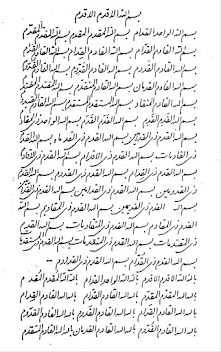
The Bayān will never surrender to the White Devil and his agenda


It becomes increasingly apparent that the tension between certain Bahá’í, Bahá’í-adjacent, and ex-Bahá’í Unitarian Universalist actors and contemporary Bābism is not merely doctrinal but structural. At root, the dispute concerns authority and interpretive control. The friction appears less about the internal coherence of the Bayān itself and more about resistance to its assimilation into a broader Western (neo-)liberal framework—one in which distinct revelatory traditions are subsumed into generalized, market-compatible spiritual identities. The underlying conflict, therefore, centers on whether the Bayān remains a self-standing metaphysical and textual system with its own claims to completion and authority, or whether it is to be rendered another symbolic resource within the marketplace of liberalized creeds. In short, the posture by some that it should further reflects a recurring modern white liberal conceit: the assumption that traditions require external supervision by those who neither inhabit nor affirm them. Such paternalistic “guardianship” presumes epistemic access without confessional participation and authority without assent. It raises an obvious tension. On what grounds can one claim to safeguard a tradition whose metaphysical premises one explicitly rejects? Critical inquiry is legitimate; derisive dismissal is not equivalent to preservation. To characterize the Bāb as “batty” in one breath while simultaneously asserting custodianship over the integrity of the Bayān introduces a performative contradiction—never mind being outright imperialist and colonialist (just like Trump threatening Iran at the moment to relinquish all defense and deterrences to its national sovereignty so that it won’t be attacked by America and Israel). Protection ordinarily presupposes a degree of reverence, or at minimum methodological restraint. Without such discipline, the stance resembles less stewardship and more of the same violent adjudication from a standpoint external to—and unaccountable before—the very tradition it claims to defend. We have indeed seen this all before by the White Devil because it is the same trick he has used repeatedly to capture traditions and denude them all of Spirit.
The essay titled “Addressing a Good-Faith Letter from a Bayani Woman” presents itself as a principled defense of historical integrity against distortion. It frames its author as a guardian of the record, a steward of nuance, and a defender of truth against charismatic inflation. Yet upon close examination, the piece is less an exercise in neutral scholarship than a declaration of epistemic sovereignty over a tradition the author does not even belong to. It is not simply defending history. It is enthroning it from a specifically white liberal First World imperialist perspective.
The central claim repeated throughout the essay is that the author is not engaging in gatekeeping, but merely allowing the text of the Bayān to “speak for itself” (never mind the fact that the author has never read the Bayān, nor knows any Persian or Arabic to do so). This assertion appears modest to those unfamiliar with the supremacist assumptions animating most white First World liberals. But it is not modest. It is violent. For a text does not “speak for itself.” It speaks through a method and a very specific Voice. To privilege historical-critical reconstruction as the only voice of a text is already to impose a tribunal (and in this case a white Western liberal institutional one). The claim to neutrality therefore collapses under its own weight. The author is not abolishing boundaries; they are redrawing them—substituting archival method for revelatory charismatic authority. In essence, whether seen or unseen by them, they are motivated by the same dynamics that made of Western Bahá’ism into a soulless bureaucratic, corporatist-administrative creed, and many others beside Bahá’ism.
The essay then insists that conceptual differentiation is not fascism but analytic clarity. This is true. Yet differentiation itself is a form of boundary enforcement. When the author asserts incompatibility between Marxism and Revelation unless reconciled under carefully constrained terms, they are performing precisely the act they deny: determining which syntheses are permissible and which are illegitimate. The gate has not vanished. It has changed hands. However, Latin American Liberation Theology as well as figures such as Ali Shariati and others in the Muslim world would beg to differ.
More revealing still is the repeated invocation of the maxim that “extraordinary claims require extraordinary evidence.” This is the fulcrum of the entire essay. It is presented as an unassailable principle of reason. But when applied to prophetic or revelatory claims, it smuggles in an unspoken metaphysical hierarchy: that Revelation must submit to the standards of Western empirical historiography or be dismissed. This is not a neutral evidentiary request. It is a jurisdictional assertion. It declares which court holds final authority. It is pure Western imperialism. Yet the essay never interrogates this hierarchy. It simply assumes that history—understood as archival verification, documentary corroboration, and critical reconstruction—constitutes the supreme tribunal. Any claim that cannot be stabilized within that framework is, by default, suspect. In this model, Revelation does not merely face scrutiny; it faces subordination.
The closing confession of the essay makes this explicit: “History is the closest thing to a god I’ll ever have.” That statement is not ornamental. It is theological. It discloses the underlying architecture of the argument. History is not merely method; it is ultimate. It is sacred arbiter. It is the final mirror. Once this is admitted, everything else follows logically. Revelation is not simply challenged; it is treated as encroachment upon a divinity already enthroned. Yet the author has admitted to a crude Stalinist Marxism that they earlier decried in such unequivocal terms.
This explains the essay’s persistent suspicion of charismatic authority, since a white First World liberal is perennially suspicious of any non-white charismatic authority, especially a male black and brown one—be they Prophet Noble Drew Ali, Martin Luther King jnr., Malcolm X, Louis Farrakhan, or even Wahid Azal. The warning against “cult of personality” is not grounded in any demonstrated coercive structure—instead it is grounded by the unspoken racism and white supremacy of the author that always seeks to project the worst of what itself is upon black and brown leaders and spiritual figures the world over. It is also grounded in epistemic displacement. The charisma of black and brown men in this age of full-spectrum Anglo-American fascism is dangerous to the sensibilities of said author not because it necessarily tyrannizes, but because it threatens to relocate the center of legitimacy and undermine the assumption of racial supremacy of the white liberal who cannot abide black and brown charisma. If Revelation is ongoing, history is dethroned—and once the white liberal’s capture of history is dethroned, with it goes his stranglehold and imprisonment of the world that he has lorded over and destroyed for 500+ years. If completion can occur through hierophanic fulfillment rather than archival certification, the archive loses its monopoly and with it the monopolization of all archives by this White Liberal Devil.
The treatment of Marxism and religion follows the same pattern. The essay gestures toward incompatibility while conceding that religious Marxism exists, even though it has for well over a century. It invokes cultural distance and philosophical tension, but it does not dismantle specific theological syntheses. Instead, it casts doubt by invoking methodological plausibility. Material demonstration—such as the Bundists (all Marxists) and early kibbutzim in Palestine manned by Jewish Marxists—is granted legitimacy because it can be empirically traced. Mystical or prophetic synthesis, by contrast, is suspect because it resists stabilization within official Western modernist documentary frameworks. Again, the hierarchy is not argued; it is presumed.
Equally striking is the essay’s oscillation between dispassionate historian and embattled protagonist. The narrative of professional struggle, identity vulnerability, fascist threat, and existential anxiety invalidate the author’s entire position by revealing its animating racial supremacist undertone. It simultaneously complicates the claim of detached neutrality. The rhetoric shifts from archive to autobiography, from record to self-defense. The argument becomes moralized: the historian under siege defending truth against harassment.
The introduction of formal “demands” near the essay’s conclusion crystallizes this shift. What begins as historiographical defense ends as conditional ultimatum. Pronoun compliance, name removal, cessation of legal filings—these are juridical claims, not scholarly arguments. The tone becomes procedural and adversarial. The author’s appeal to mercy coexists with enforcement posture. The scholar speaks, but so does the litigant. At its core, the essay is not arguing that revelation is impossible. It is arguing that Revelation must answer to history. It is not denying spiritual experience; it is subordinating it to documentation—an absurdity that generations of mystics have answered and been institutionally persecuted by. This is because it not abolishing authority; it is relocating it. The archive replaces the prophet. The historian replaces the sage. The footnote replaces the flame. White gatekeeping manages the whole thing
The conflict, therefore, is not between violence and scholarship, nor between fascism and freedom. It is between rival sacreds. One model locates legitimacy in the evolving, documented memory of humanity—history as sovereign. The other locates legitimacy in ongoing manifestation—authority as eruption. These frameworks are structurally incompatible at the level of ultimate arbitration. To pretend otherwise is to mask metaphysical disagreement as procedural dispute. What the essay thus calls “defense of the record” is, in fact, defense of jurisdiction and a defense of white supremacy. What it calls “extraordinary evidence” is a demand that Revelation present itself in the language of the archive for the benefit of the straitjacketed universe of the White Liberal Devil. What it calls “cultism” is suspicion of any authority not licensed by white historiography. And what it calls neutrality is allegiance to capitalist hegemony and the domination of white supremacy and its lenses.
The essay does not even exhibit moral conviction. Its obvious weakness lies in its unexamined absolutism. By elevating history to quasi-divine status, it cannot tolerate Revelation except as historical artifact. It may study prophets; it cannot abide prophecy. Until this deeper divergence is acknowledged, the debate will remain mischaracterized as a quarrel over facts. It is not about facts. It is about which tribunal reigns supreme. For one side, the archive is final. For the other, Manifestation is ongoing. One bows to the document. The other bows to the possibility that the document is not the last word. History, in this vision, is god. Revelation is heresy. Of course, to us this is a definition of idolatry. And that is the true axis of the conflict.
Given this, the Bayān will never be surrendered to this White Devil—ever!—and, furthermore, all other demands are likewise categorically rejected. QED!