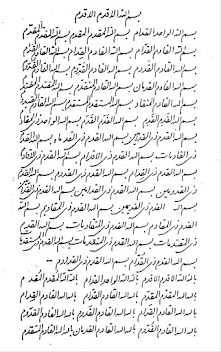
The Story of Samā’ullāh (Jamshid Maʿānī)

Someone recently made the following post on the UHJ-surveillanced, controlled-opposition subreddit r/exbahai.
“I have been trying to reconstruct the history of one of the most obscure post-Bahá’í religious claimants, who even my family has had history with and still believe to this day: Jamshid (Jamshed) Maʿānī (Persian: جمشید معانی), an Iranian Bahá’í missionary who, sometime around the early to mid-1960s, appears to have transformed from a highly successful Bahá’í pioneer into the founder of a small independent revelatory movement of his own. I can’t find much information about him, except for scattered references across Bahá’í memoirs, some Persian articles, archived Google group discussions, and random mentions of him in bibliographies and surviving publication listings. What I’ve learnt all points to the fact that this man was once the center of a small international schism.
My grandmother and family still believe in him, and they have a weird twelver-shia + Jamshidi view on how he’s ‘Imam Mahdi’, and in order to discuss it more with them I wanted to look for more information on the guy.
I am putting everything I have found so far into this long post in the hope that someone else may know more, possess documents, or have family memory of this movement.
Here’s what I’ve compiled:
Jamshid Maʿānī did not begin as an outsider. All evidence suggests that he emerged from inside the formal Bahá’í missionary apparatus. Multiple Bahá’í recollections describe him as a charismatic Iranian muballigh (traveling teacher/public speaker) from a prominent Bahá’í family. Some online discussants familiar with Iranian Bahá’í history even state that his family had served Bahá’í institutions for two generations, and that some of his relatives remained loyal to Haifa after his split. He is repeatedly described in these early years as eloquent, handsome, deeply detached, mystical in demeanor, and unusually effective in missionary work. One memoir source, ‘Servants of the Glory: 40 Years of Pioneering’, gives one of the clearest institutional snapshots of him before his break. There he appears as the assistant of Dr. Muhájir in the Indonesian field, working in Mentawai and later sent by the Southeast Asian National Spiritual Assembly in 1963 to Sarawak and Borneo, where he reportedly enrolled approximately 6,000 Dyak tribespeople into the Bahá’í Faith. The memoir writer says the Dyaks believed a man would come bringing a new religion and therefore accepted him readily, and that Jamshid was seen at that time as one of the great success stories of Bahá’í pioneering. Another recollection says he resembled Jesus Christ in appearance and was thought by fellow pioneers to possess an, “extraordinary spiritual aura”.
Around 1963–1964, shortly before or around the establishment of the Universal House of Justice, Jamshid Maʿānī appears to have begun privately advancing claims that he himself had become a new divinely appointed figure. Several independent sources agree on this timeline. Bahá’í memoir accounts say that he announced after a dream or revelatory experience that Bahá’u’lláh had told him he was the next prophet. Persian literature says he surfaced as one of the post-Shoghi claimants exploiting the succession confusion after Shoghi Effendi died in 1957 without a successor. Other online discussion posts state that on a visit to Iran he quietly informed family members and local believers that he was not merely a teacher but the Third Manifestation of God after the Báb and Bahá’u’lláh, sent to inaugurate an entirely new dispensation. One poster even summarizes his claim in the extraordinary phrase that he presented himself as “the One Who creates the Messengers at every instant.”
The titles under which he operated are fascinating and seem to show an escalation in self-presentation. In English publications he publicly styled himself simply as “The Man” or “Insān.” At first glance this can sound humble, and some later followers such as ones in my family apparently interpreted it that way - as if he were only saying “I am merely a human being.” But the doctrinal context strongly suggests this was not humility at all. In metaphysical vocabulary, al-Insān can invoke the idea of the Perfect Man, the completed archetype of humanity, the one in whom divine attributes are fully reflected. Several surviving descriptions of his movement explicitly say that the title “The Man” was used to signify that humanity had entered a new stage of maturity and that the “real station of man is spiritual.” In other words he was presenting himself as the exemplary or perfected human through whom a new stage of revelation had arrived. Later Persian sources say he also used the title Samāʾu’llāh / Samaullah (سماءالله), literally “The Heaven of God” or “Firmament of God,” and one archived source says he referred to himself in writing as Qalam al-Ahmar, the Crimson Pen.
From this point onward his movement began to crystallize into what references call “Faith of God.” This was apparently a fully structured mini-religion. It had an administrative branch called the House of Mankind, echoing the Bahá’í House of Justice, and a projected future world institution called the Universal Palace of Order. The movement retained the Bahá’í doctrine of progressive revelation but inserted Jamshid as the newest revealer in the chain after Zoroaster, Moses, Jesus, Muhammad, the Báb and Bahá’u’lláh. Some surviving descriptions say he taught that all worship was acceptable so long as it was not contrary to wisdom, that the universe was alive and evolving, and that humanity was entering spiritual perfection under his dispensation. His new era would have no binding shari‘a or religious law whatsoever, suggesting he was presenting his revelation as a law-transcending universal maturity. This may explain why some Persian critics treated him not merely as a Bahá’í dissident but as a total post-Bahá’í claimant.
Jamshid also left behind books. Bibliographic listings from Bahá’í archives and compilations preserve a surprisingly rich publication trail. Known titles associated with him include:
To the Bahá’í Community Throughout the World (1967),
Prayers of the Man for All Mankind (published in Lahore in 1970),
God, Heaven, The Reason of Man’s Creation,
The Sun of the Word of the Man,
Universal Order,
and references to Kitab-e-Insan or Book of Man.
I can’t find copies of these online but I’d appreciate if anyone can share them with me, if they have any of these. My family isn’t willing to share anything with me.
Several of these were privately printed in Mariposa, California around 1971. Some readers who saw samples of his texts say he emulated Bahá’u’lláh’s Arabic/Persian prose style so closely that portions felt almost plagiarized or consciously imitative of Bahá’í scripture. This may explain why early seekers found the literature compelling before meeting him in person, one of them being John Carré.
Carré was himself already a complicated post-Bahá’í personality, having earlier supported the claims of Mason Remey after the Bahá’í succession crisis. After becoming disillusioned with Remey, Carré encountered Jamshid Maʿānī and appears to have become his principal American champion. Multiple bibliographic records list Carré as translator, compiler, editor, or publication associate on Maʿānī’s books. The California printing addresses, the English-language editions, and the establishment of the House of Mankind in the United States all seem to run through Carré’s home in Mariposa. Carré later admitted in archived correspondence that he joined Jamshid because Maʿānī’s writings “echoed the spiritual teachings of the Bahá’í Faith” and because in a time of Bahá’í confusion he thought it better to investigate than dismiss. He then traveled among Jamshid’s followers in Iran, England, Mauritius, Pakistan and South America. He even visited my family apparently in the 70s.
Yet Carré also became the central witness to the movement’s collapse. In a later candid statement he wrote that Jamshid came to stay in his California home for several months and that, despite the beauty of the writings, Carré and his family concluded he was “not what he claimed to be.” In another source this judgment is phrased even more bluntly: Jamshid was “not at all godly or spiritual, and certainly was not a Manifestation of God.” Carré says he sold a cabin to pay Jamshid’s airfare back to Iran and then informed the followers of his findings, an act which “decimated his community.” Nancy Carré independently corroborates this, saying her parents initially accepted Jamshid, later discovered the writings were heavily derivative, and knew with certainty after meeting him in America that something was deeply wrong. This falling out appears to have been catastrophic. The American House of Mankind ceased functioning soon after, and Carré spent the rest of his life distancing himself from that episode, though he never fully stopped eschatological speculation.
So one of the largest pillars of Jamshid’s movement, his Western publication and financing network, was suddenly gone by the mid-1970s. But the movement had another major branch: Pakistan.
This is where the story becomes especially strange. A number of Persian and Urdu references explicitly mention that Pakistani Bahá’īs were drawn into Jamshid’s orbit. One archived advertisement-like note which I found reads almost like missionary outreach:
“Jamshed Mani ‘The Man’ from Iran, in 1964 claimed to be the next manifestation of God after Bahaullah… Any one interested about the faith can contact Syed Nawazish Ali Shah, a renowned disciple of Jamshed Mani, at 170-BB D.H.A. Lahore Cantt, Pakistan.”
This Nawazish, a retired Major in the Pakistan Army, was also one of the main carriers of Jamshids legacy and is who even my family was involved with and who got them into the sect. In other Bahai libraries you can also see that a book by Jamshid, ‘Prayers of the Man for All Mankind’, was also translated and printed in Lahore in 1970. Persian analyses of Bahá’īs in Pakistan likewise mention Jamshid Maʿānī as one of the internal schismatic currents affecting Pakistani Bahá’īs. This suggests that a small but real Pakistani Samavī/Insānī network existed.
And this is all I have gotten so far. Present-day oral memory from my family begins to conflict with internet history. Most surviving Bahá’í or ex-Bahá’í sources imply that Jamshid’s organized movement effectively collapsed by the mid to late 1970s after Carré withdrew, his writings were discredited, and concerns about his mental health intensified. Some accounts say he was hospitalized in Tehran. One Bahá’í anecdote says very bluntly that “the poor guy went crazy” and claimed to be a messenger of God, eventually dying in a mental institution in Tehran. Another older archived post from a Google group says he later lived in seclusion somewhere near the Caspian Sea and had “completely lost his cookies.” Yet these same internet-visible sources are contradicted by persistent family memories from Pakistani circles like that of my grandmother, who claimed that she and my aunts and uncles visited Jamshid personally in Iran even in the late 1990s and early 2000s. This implies that the movement survived privately in hidden devotional networks long after it had ceased to exist publicly in Bahá’í discourse? The way they talk about him is very similar to cult-worship, hence why I’m so curious about this and went down this rabbithole.
There are also repeated suggestions that his followers were called Firqa Samavī (from Samāʾu’llāh) or were informally known simply as followers of Insān/The Man. Whether there was ever a self-conscious institutional “Samavī” denomination or whether this is a label retroactively used by Persian critics is still unclear, or my internet geoblocks most websites which can provide me with more information on this.
Then there is the final unresolved matter of his later life. Some sources say he returned to Iran after the California break. Some claim he resurfaced briefly in Northern California in the late 1980s. Others say he later went back again to Iran. Some place him in Karaj. Others place him in seclusion near the Caspian. Some insist he died in psychiatric confinement. I do know from my family that he died because they tried visiting again in 2010s and were informed of his passing. I have not yet found a definitive obituary, death certificate, burial notice, or firsthand account of his final years. And again, my family doesn’t like sharing anything about it with me. I did find that his brother Hedi Ma’ani was murdered in New Zealand, but that was from a fringe podcast I found on this subreddit and also can’t find much more about it.
So as of now, this is what seems reasonably reconstruction: Jamshid Maʿānī was an Iranian Bahá’í missionary of considerable success in Indonesia and Southeast Asia who, amid the post-Shoghi succession confusion, announced himself around 1963–64 as a new revelatory figure under titles such as The Man/Insān, Samāʾu’llāh, and possibly the Crimson Pen; he built a post-Bahá’í religion called Faith of God with institutions called House of Mankind and Universal Palace of Order; he published multiple books in Iran, Pakistan and California; he attracted followers in Iran, Pakistan, England, Mauritius, South America and the United States; he was heavily sponsored and translated by John Carré until Carré personally met him and concluded he was not spiritually authentic; this rupture decimated the movement publicly in America; reports of mental collapse then begin to dominate Bahá’í memory; yet there are lingering indications that private Pakistani and Iranian adherent circles may have continued revering him for decades after the movement was thought dead.
I am posting all this because I am convinced there is much more here than the internet currently preserves. I want to learn more about what happened; but for that I’d also appreciate any evidence that points to him being hospitalized etc.
Also, if anyone has:
old pamphlets, scans, PDFs, copies of Kitab-e-Insan, photographs, John Carré correspondence, Persian/Urdu/Bahasa references, memories from Pakistan/Iran/Indonesia, or any family connection to followers of Jamshid Maʿānī / Samaullah / The Man, please comment or message me.”
—
My answer: I know a little about Samāʿuʾllāh through family connections. One of his UHJ-appointed interrogators from the 1960s—the late father of Soheil Abedian—was the father of my aunt’s ex-husband. I have also read fragments of Jamshīd Maʿānī’s Persian-Arabic writings, which are essentially rehashes and pastiches of Bahāʾuʾllāh’s own stylistic register. Together with the epithet Samāʿuʾllāh (the Heaven of God), Jamshīd Maʿānī also called himself Qalam-i-Sorkh/Qalam al-Aḥmar (the Crimson Pen)—very reminiscent of the Suhrawardian ʿAql-i-Sorkh (the Crimson Intellect) who is the Active Intellect (ʿaql-i-faʿāl) whom Suhrawardī’s system identifies with the archangel Gabriel (the Angel of Revelation). Also, when the hamza’ (ء) after the alif of samāʾ be counted, the epithet Samāʿuʾllāh (سماء الله) itself holds the numerical value of 168 which is equivalent to Bismillāh (“In the Name of God”), showing how Maʿānī was well versed in his Persian Islamic arcana and lettrism (ʿilm-i-ḥurūf).
That aside, one should be cautious about the standard “he went insane” narrative pushed by the Bahāʾīs. Bahāʾī institutional memory—and those adjacent or aligned with it—has historically pathologized schismatics almost automatically. The same pattern was applied to Ṣubḥ-i-Azal (d. 1912), Mason Remey (d. 1974), Aḥmad Sohrab (d. 1958), numerous other Covenant-Breakers (CBs), and even myself. In these contexts, psychopathologization functions primarily as weaponized political smear.
According to word-of-mouth testimony circulating through family networks, Jamshīd Maʿānī was still alive sometime between 2004–2006 and had apparently resumed limited activity within Iran itself, where he was then residing. The Islamic Republic seems largely to have left him alone due to his and his followers’ hostility toward the UHJ and the Haifan establishment. Around 2008–2009, I attempted to contact him in order to challenge him to produce a superior commentary to mine on the symbol of the Greatest Name, only to discover near the end of 2009 that he had already passed away. He does not appear to have survived beyond the first decade of the 2000s.
Now, I would also caution any followers of Samāʿuʾllāh lurking online to be wary of forums such as Reddit’s r/exbahai. Despite its pretensions to independence, it is not a legitimate neutral space and often functions more like an informal surveillance front for the UHJ itself—which, in my view, operates within broader Israeli intelligence and military alignments. I say this because long-circulating family-network rumors held that the UHJ spent years unsuccessfully attempting to eliminate Jamshīd Maʿānī (yes, you heard that right: rumors have it that the Universal House of Justice in Haifa, occupied Palestine for years attempted to have Jamshīd Maʿānī murdered). This may partly explain why the Iranian state allowed him to reside quietly inside Iran without seriously harassing him: the authorities likely understood that the Haifan establishment already regarded him as an enemy. As such, he and his remaining followers seem to have been tolerated—or quietly shielded—without being permitted to develop an open movement within Iranian borders.
As for John Carré (his one time putative follower): he was a difficult personality. I knew him online and did not like him. He struck me as typical of a certain kind of white American enthusiast who becomes intensely attached to a movement or charismatic figure only to lose interest once the novelty fades. There has also long been speculation that Carré may have been connected to intelligence circles in some capacity, and that his association with Jamshīd Maʿānī functioned, at least in part, to discredit him. This is due to the fact, as it should be stated for the record, that the story about Maʿānī’s paranoia regarding Iranians trying to kill him was intentionally obscured.
Any paranoia regarding his physical elimination did not so much come from the Iranians, but from those constellation of forces aligned directly to the Universal House of Justice itself, i.e. the Haifan Bahā’ī establishment. This is because had Jamshīd Maʿānī actually been apprehensive of the Iranians trying to kill him, he would never have returned to Iran. Instead he did—i.e. relocate back to his native Iran. Note that while Maʿānī largely stayed away from Iran during the last decade and a half of the Pahlavi regime when the Bahā’īs were both socially and institutionally ascendant (and particularly in the Shah’s SAVAK), he relocated back to Iran during the 1980s after the Islamic Revolution. Maʿānī’s legitimate fear was always with the Haifan Bahā’īs—and not with the Iranians. But in order to sell a credible story to discredit him when he could not defend himself, John Carré instead fabricated the narrative about Maʿānī’s fear of the Iranians. This, in itself, should tell us all we need to know about the late John Carré.
That stated, this fear of the Haifan Bahā’ī Universal House of Justice on the part of Jamshīd Maʿānī was very much a legitimate fear. His younger brother, Hedi Moani, was in fact murdered in New Zealand during the 1990s in a very suspicious incident that has all the hallmarks of a set-up. Hedi Moani had been a member of the National Spiritual Assembly of the Bahā’īs of New Zealand and had progressively had a falling out with the system as a whole—including with his own brother Daryush Maʿānī (d. 2012), a Continental Board of Counsellors member, and another sibling of Jamshīd Maʿānī’s. Family rumors have it that the late Hedi Moani had at the time been seriously considering withdrawing from the Haifan Bahā’ī organization and re-uniting with Jamshīd Maʿānī and his parents in Iran (who had earlier followed their son out of Bahā’ism and where old and dying at the time). Hedi Moani had apparently expressed his intentions more than once publicly, and not long thereafter he was mysteriously murdered in his own New Zealand home.
And God speaks the Truth and guides upon the Way!