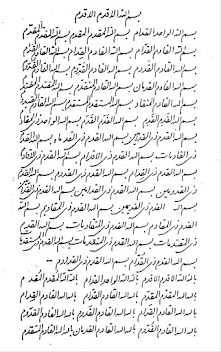
The Prophet of Shiraz: Reflections on an Iranian Spiritual Experience by Mehdi Arabshahi (Translated by Wahid Azal)

Original Persian on his Telegram page.

The Bāb may be approached from many different perspectives: the history of religion, the emergence of the Bābī movement, the rise of the Bahāʾī Faith, the suppression of religious dissent, or the role played by certain Bābīs and Azalīs in the Constitutional Revolution. Yet before all these, perhaps He ought to be considered neither from the standpoint of faith nor that of denial, but as a profoundly Iranian spiritual experience—an experience born of the Shiʿi tradition, the language of mysticism, the expectation of the Promised One, and the enduring historical yearning of the Iranian soul for the opening of a new Gate.
Sayyid ʿAlī Muḥammad of Shiraz, the young man who would later be executed at Tabriz, first called Himself the Bāb—the Gate, the Threshold, the Passage. That very title may provide the key to understanding the first layer of His experience. The Bāb understood Himself as a Gate, standing between Occultation and Manifestation, expectation and fulfilment, silence and the Word.
Within the Shiʿi tradition of Iran, expectation was never merely a theological doctrine. It constituted a psychological and historical condition: centuries spent inhabiting a world in which perfect truth remained concealed in Occultation, ultimate justice was endlessly deferred, and the existing order was experienced as incomplete and unfinished. The believer, within such a tradition, perpetually lives upon the threshold, awaiting the lifting of a veil and the restoration of meaning to the world.
It was from the heart of precisely this world that the Bāb arose—from Shiraz, a city which the Iranian imagination associates with poetry, mystery, gardens, fragrance, interpretation, and the sacred art of spiritual irony. Yet the Shiraz of the Bāb was not merely the city of roses and ghazals. It was a city situated within Qājār Iran: a weary world burdened by an entrenched clerical establishment, an increasingly enfeebled monarchy, and a society suspended uneasily between an ancient tradition and the first intimations of a new age.
Within such a setting, the title Bāb was more than a religious designation. It was the image of a Gate that might suddenly open.
The earliest significance of the Bāb perhaps lay in this: He transformed expectation from a state of stillness into an event. In His experience, expectation was no longer merely the patient endurance of an unknown future; it suddenly became something actual. That which was destined to arrive one day was brought, in His language, into the immediacy of the present.
Seen from this perspective, the Bāb may be regarded as one of the most radical figures in the Iranian tradition of messianic expectation—not because He merely awaited fulfilment, but because He fundamentally altered the very structure of expectation itself. He proposed that Manifestation might not simply be an event reserved for the end of history. Perhaps the Threshold lies not somewhere outside the human being. Perhaps the Gate may suddenly appear in the language, the body, the vision, and the spiritual unveiling of a young man from Shiraz.
Such an experience transcends the confines of theological controversy. Throughout the history of Iranian mysticism we repeatedly encounter figures who understand themselves as the locus through which meaning passes. The mystic, at the moment of unveiling, does not possess the Truth; rather, he becomes its vessel. Truth passes through him. The Word traverses his being. Accordingly, the symbolic language of Iranian mysticism abounds with images of the mirror, the veil, epiphany (tajallī), the path, the gate, the threshold, and passage.
In the very first title He chose for Himself, the Bāb situated Himself within precisely this symbolic universe. The Gate signifies that which points beyond itself.
The experience of the Bāb, however, did not remain confined to the frontiers of mysticism. He gradually moved beyond the station of Bābhood itself, advanced claims to be the Qāʾim, and ultimately proclaimed the advent of a new religious Dispensation, producing writings that would later give rise to an entirely new religious tradition. Yet the root of His experience remained that first moment: the moment when a man arose from within a tradition saturated with expectation and declared that the Gate had been opened.
For His followers, these words were glad tidings. For His opponents, they were a profound danger. Every gate, if it truly is a gate, threatens the order that preceded it. Established institutions have little difficulty with expectation, provided that expectation remains tranquil, distant, and manageable. But the moment someone proclaims that expectation has reached the threshold of fulfilment, the jurist, the ruler, and the established social order alike begin to perceive a threat.
The Bāb may therefore be studied without requiring belief in Him. One may reflect upon His significance without entering into theological judgement. Seen in this light, the Bāb is not merely the name of an individual; He is the name of a moment—the moment when the tradition of expectation realised that it could no longer remain content merely to wait.
The threshold is the place between remaining and departing.
In its earliest and most fundamental sense, the Bāb was the name of that very threshold.
Part Two: The Word and the Bayān
If, in the first part, we considered the Bāb in relation to the Threshold and the tradition of messianic expectation, the next step is to draw nearer to His language—a language that often resembles mystical disclosure more than rational argument, and the eruption of meaning more than a calm and orderly exposition of doctrine.
The Bāb spoke into a world in which religion had, more than anything else, been reduced to the repetition of inherited texts, imitation of juridical authority, and the preservation of the established order. In His experience, however, the Word once again became an event. Scripture was no longer merely something to be read; it became something capable of recreating the world.
From this perspective, the significance of the Bāb lies not merely in what He said, but in how He said it. His language is filled with letters, numbers, the Point, Unity (Wāḥid), the Kull Shayʾ (”All Things”), return (rajʿa), resurrection (qiyāma), Manifestation, and the Bayān—a symbolic universe in which every word may become a gate and every letter a sign of a hidden order. To the modern reader this language often appears difficult, strange, even bewildering. Yet that very strangeness forms part of its meaning. The Bāb sought to wrench ordinary language free from the habits into which it had fallen.
Within the Iranian mystical tradition, the Word has always been more than a mere instrument of communication. The divine command “Be!” (kun) in the sacred texts is not simply an imperative; it is the beginning of creation itself. In mystical poetry, to utter the name of the Beloved is already to participate in His presence. Within the Illuminationist (Ishrāqī) tradition, Light is not merely a metaphor but the very mode through which reality is understood. In such a tradition, language becomes the locus of divine epiphany—the place where meaning emerges from the Unseen into Manifestation.
The Bāb stood firmly within this symbolic world, yet He carried it to a more radical conclusion. In His writings the universe seems to return once more to the Point and to the Letter—to the very beginning of writing itself. The Bayān is not merely the title of a book or a collection of laws; it is the name of a world demanding to be read anew. Through language He fashioned a new order, one in which time, number, the Word, and Manifestation are woven together into a single symbolic fabric.
One may arrive at widely differing judgements regarding the religious claims of the Bāb. Yet it is impossible to deny that, within His experience, language itself became the principal theatre of the spiritual event. Before He founded a community, before His followers became embroiled in persecution and conflict, He first created a linguistic universe—a world in which the Word once again claimed the power of creation.
Seen in this light, the experience of the Bāb forms part of the larger history of the Iranian search for a sacred language. The same impulse that appears in the poetry of Ḥāfiẓ, in the ecstatic utterances (shaṭaḥāt) of the Ṣūfīs, in esoteric hermeneutics (taʾwīl), and in the symbolic numerology and letter mysticism of Iranian traditions assumed a new form in the language of the Bāb. The difference lay in this: He employed that language not merely for the sake of individual spiritual wayfaring, but to proclaim the transformation of an entire age.
From this perspective, the Bayān may be understood as an attempt to awaken language from its slumber. It is as though the Bāb wished to declare that words had grown old, that meaning had withered beneath the crust of habit, and that the world itself required a new naming. It is precisely here that His experience transcends the category of religious reform and becomes at once a poetic, mystical, and historical event.
Perhaps this is why reading the Bāb—even from a standpoint devoid of belief—is never merely an encounter with a religious text. It is an encounter with a human being who took language with absolute seriousness—so seriously, indeed, that He appeared to perceive the destiny of the world in the relationship between the Point and the Word, between Occultation and Manifestation, between silence and the Bayān.
In this sense, before He was the founder of a religion, the Bāb recalled a forgotten possibility: that the world may yet be read anew.
And perhaps this is the deepest meaning of the Bayān itself: the endeavour to restore the world to that primordial moment when the Word is still alive.
The Bāb may be read through the lens of faith or through that of denial. But there is yet another way: to view Him as the sign of an unfinished renaissance in the Iranian-Islamic world—a renaissance that arose from within tradition, spoke in the language of that very tradition, yet gradually displaced its boundaries.
In European history, Protestantism was not merely a religious dispute; it represented the breaking of the Church’s monopoly over the interpretation of religion, the sacred text, and the relationship between man and God. If one employs the analogy with due caution, the movement of the Bāb may likewise be understood as an Iranian attempt to break the monopoly of the jurists over religion—not in precisely the same sense as the Christian experience of Europe, but as an effort to open a new path between humanity, revelation, manifestation, and the sacred itself.
The Bāb did not come from outside the tradition. His language, His concepts—the expectation of the Promised One, return (rajʿa), resurrection (qiyāma), the Qāʾim, esoteric interpretation (taʾwīl), and revelation—all emerged from the very heart of the Shiʿi world. Yet His work did not remain confined within that framework. Employing the inner language of tradition, He carried that tradition itself to the point of explosion. It was as though He spoke from within an ancient house, yet opened windows through which a fresh wind began to enter.
For the Bāb, religion was not merely the inheritance of the past. Truth could not remain imprisoned forever within ancient texts. If God is living, then the Word too must be capable of living anew. If history continues, then manifestation cannot remain merely a memory of the past or a distant promise deferred to the future. Such a vision was profoundly unsettling to the juridical and political order of the age.
The jurists did not confront this experience merely as an abstract theological proposition. If the Bāb possessed the authority to speak directly from the realm of the sacred, then the official monopoly over religious interpretation was shaken. If manifestation could occur outside established institutions, then the settled religious hierarchy could no longer claim to be the sole gateway to truth. If a new revelation was possible, then the past could no longer dictate the entirety of the future.
The Qājār state grasped the danger equally well. For the ruler, the issue was not simply a religious claim; it was a social order that threatened to slip beyond political control. A movement travelling from city to city, gathering devoted followers, mobilising both women and men, and fashioning a new language for the end of one age and the beginning of another could not be dismissed as politically insignificant.
Thus there emerged the alliance between jurist and sovereign: the one speaking the language of takfīr, the other the language of prison and bullets. What might have become a great conversation concerning the renewal of religion, liberty of conscience, the relationship between humanity and scripture, and the possibility of fresh manifestation, was rapidly transformed into a theatre of repression.
From this perspective, the suppression of the Bāb was not merely the elimination of an individual; it was the closing of a historical possibility. It represented the possibility that the Islamic world—at least in its Iranian branch—might confront from within the questions of religious reform, freedom of interpretation, and the right to immediate experience of the sacred. This possibility was neither complete nor free of contradictions, nor necessarily consonant with contemporary notions of liberty and modernity. Yet it was alive, restless, and pregnant with new paths yet to be explored.
It is perhaps for this reason that one may speak of the Bāb as the beginning of an unfinished renaissance—a renaissance which, before it had the opportunity to mature through dialogue, criticism, transformation, and growth, encountered the fear of the old order. The jurists saw in it innovation (bidʿa); the rulers perceived rebellion; and a society that had not yet learned the language of tolerating dissent was more inclined to fear than to understand.
Read in this way, the Bāb is not merely the founder of a new religion. He signifies that fleeting historical moment in which tradition glimpsed the possibility of its own regeneration. Yet that possibility remained unfinished—in blood, exile, excommunication, and execution.
An unfinished renaissance is precisely this: a door was opened, but before society could pass through it, power hastened to shut it once more.
If the Bāb may be regarded as the sign of a new threshold within the tradition of messianic expectation, then Ṭāhira must be seen as one of the clearest embodiments of crossing that threshold—a woman who arose within a religious movement, yet whose significance extended far beyond theology. She became the symbol of a social, linguistic, and even bodily rupture with the old world.
Fāṭima Baraghānī, better known as Ṭāhira Qurrat al-ʿAyn, was born into a distinguished clerical family in Qazvīn. She was a poet, theologian, exegete, and formidable disputant—a woman who, in a profoundly masculine world, stood not upon the margins of silence but at the very centre of discourse. Her importance lay not merely in her acceptance of the Bāb’s cause; rather, within this new spiritual experience, woman ceased to be merely the object of religious judgement and became the subject who herself uttered the Word.
Within traditional societies, woman had generally been regarded as an object of social order: she was to be veiled, restricted, defined, protected, and her place determined by men. Ṭāhira, however, within the Bābī experience, was not merely someone about whom others spoke; she herself became the speaker. She composed poetry, interpreted scripture, engaged in theological debate, travelled extensively, and assumed an active role among religious men.
The episode of Badasht, however one chooses to narrate it, remains among the most symbolically charged moments of this rupture. Ṭāhira appeared unveiled before an assembly of the Bāb’s followers—an act which, in nineteenth-century Iran, was far more than an individual gesture. Within the symbolic language of that age, it signified the passing beyond the previous dispensation and entry into a new era. For some it was shocking; for others liberating; for the established order it was profoundly dangerous.
One should not impose contemporary standards upon the entire Bābī movement by depicting it as wholly modern or egalitarian in the present-day sense. Yet neither can one deny that Ṭāhira’s presence shattered something fundamental within the old world. She demonstrated that if a spiritual experience is genuinely new, it cannot remain confined to books and words; it inevitably extends to the body, dress, voice, presence, and the relationship between woman and man.
Herein lies the significance of the relationship between the Bāb and Ṭāhira. The Bāb supported her, and within the Bābī tradition she occupied an exceptional station. This support was not merely the defence of an individual; it signified that genuine spiritual openness is inseparable from social upheaval. Once a new door is opened, not only do texts change, but the place of human beings themselves is transformed.
Ṭāhira may be situated upon the frontier between Iranian mysticism and Iranian modernity. On the one hand, her language was that of love, meaning, faith, and illumination. On the other, her very presence posed an unmistakably earthly question: Can woman herself become the bearer of meaning? Can she speak without mediation? Can she step forth from behind the veil—not merely as a listener, but as an interpreter of the world?
These were precisely the questions that rendered Ṭāhira dangerous. She wielded neither sword nor state; yet she possessed a voice capable of shaking the symbolic order of her age. A society that might have tolerated a woman poet found it far more difficult to tolerate a woman who united poetry, exegesis, faith, and public presence into a single reality.
Ṭāhira was eventually put to death during the repression of the Bābīs. Yet, like so many liminal figures in history, her death did not mark the end of her significance. Within Iranian memory—especially in Bābī and Bahāʾī narratives—she became an enduring symbol of feminine courage, the breaking of ancient veils, and the union of the Word with freedom.
Within that brief and turbulent experience, something of Iran’s future became visible: a woman who moved from the margins to the centre, from silence to speech, from the object of judgement to the subject who confers meaning.
If the Bāb was the name of the threshold, Ṭāhira was perhaps the first to demonstrate that crossing the threshold is never merely an inward act. Every great spiritual experience, if it truly shakes the world, sooner or later reaches the body, society, woman, language, and liberty.
In the history of Iran, Ṭāhira remains one of the enduring names of that crossing.
Every spiritual experience, if it transcends the bounds of individual mystical disclosure, sooner or later enters history. The Bāb, too, did not remain confined to the sphere of prayer, esoteric hermeneutics (taʾwīl), manifestation, and the Word. The movement inaugurated in His name, despite persecution, execution, and dispersion, continued within the hidden strata of Iranian history, and part of its spiritual energy later resurfaced in the realms of intellectual life, modern education, journalism, and the Constitutional Revolution.
This is not to suggest that the Constitutional Movement should be regarded as the product of the Bābīs. Constitutionalism emerged from a broad coalition of clerics, merchants, intellectuals, journalists, political societies, and diverse social forces. Yet it cannot be overlooked that a number of Bābīs, Azalīs, and individuals influenced by their intellectual milieu contributed to shaping the emerging discourse of constitutional law, liberty, the ʿadālat-khāna (House of Justice), and modern education.
This connection was no accident. Anyone who took the experience of the Bāb seriously was inevitably confronted with a fundamental question: if a new gate had been opened in the understanding of religion, could not a new gate likewise be opened in politics, society, and public life? If the religious text could be liberated from the monopoly of official interpretation, could political power not also be wrested from the monopoly of the monarch and his court? If the human being could encounter meaning more directly, might not the citizen likewise participate more directly in determining his own destiny?
In this sense, a hidden thread runs between the spiritual experience of the Bāb and the horizon of constitutionalism: the thread of breaking monopolies. On one side stood the challenge to the jurists’ monopoly over meaning and the interpretation of religion; on the other, the challenge to the Shah’s monopoly over law and political authority. Both, in their own distinct ways, confronted the same question: must the Iranian merely remain an obedient subject, or could he also become an interpreter, an author, a citizen, and a bearer of rights?
A portion of those who survived the Bābī movement—particularly the Azalīs—instead of constructing a closed religious community, gravitated toward cultural and political activity. They became active in newspapers, learned societies, modern schools, and intellectual circles. Some stood alongside other constitutionalists in advocating constitutional law, representative government, the House of Justice, and the limitation of arbitrary power.
It is in this light that one may understand why the epithet Bābī became, during the Constitutional era, simultaneously a religious identity, a political accusation, and a symbol of fear. Opponents of reform habitually branded many modernists as Bābīs, as though anyone who championed constitutional government, modern education, freedom of the press, or the curtailment of absolutism must somehow be associated with that same “dangerous gate.”
This very practice of accusation reveals that the experience of the Bāb remained alive within the political memory of Iran long after its bloody suppression. For the old order, a Bābī was not simply one who professed heterodox beliefs; the Bābī symbolized the individual who sought to transgress the accepted boundaries. That image simultaneously inspired fear and embodied possibility.
The Constitutional Revolution, of course, did not fully establish freedom of conscience. Bābīs and Bahāʾīs alike remained outside the officially recognised boundaries of religious citizenship. Yet the language of constitutionalism, for all its limitations, represented the continuation of the same great question: Is it possible to be Iranian and yet possess rights? Is it possible to be a believer, an unbeliever, a dissenter, or simply different, and nevertheless remain a citizen?
Viewed from this perspective, the Bāb belongs not merely to the history of religion. He also occupies a hidden place within the political history of Iran—not because He drafted a political programme, but because His experience constituted one of the earliest great tremors in the edifice of traditional authority.
The Bāb opened a gate within the realm of meaning.
The constitutionalists, each by a different path, sought to open a gate within the realm of power.
Between these two gates stands the unfinished history of Iranian liberty.
The fate of movements is not exhausted by either victory or defeat. There are times when a movement neither triumphs completely nor is wholly destroyed; instead, it diffuses through history. Its name endures, its legacy survives, the fear it inspired remains, yet its adherents gradually either follow another path or retreat into silence, taqiyya, and hidden existence.
Such was the fate of the Bābīs.
Following the execution of the Bāb, that passionate and perilous movement did not continue along a single trajectory. The greater part of His followers eventually accepted the summons of Bahāʾuʾllāh and continued within the Bahāʾī Faith. Others remained loyal to Ṣubḥ-i Azal and came to be known as the Azalīs, or Bayānīs. Yet this latter branch, unlike the ardent dynamism that had characterised the earliest days of Bābism, gradually receded from the centre of history.
In the decades that followed, the Azalīs occasionally exercised a hidden yet consequential influence. Some became active within intellectual circles, modern education, journalism, and the Constitutional Movement. Yet they seldom sought to reconstruct themselves as an openly organised religious community. The severity of the persecutions they had endured, the ever-present threat of takfīr, social ostracism, and the traumatic memory of repeated massacres inclined them toward caution, concealment, and taqiyya.
In Iran, there are times when survival requires one to conceal one’s very name. This was the course the Azalīs adopted. Many ceased all public proclamation of their beliefs. Their convictions became matters of family, intimate circles, and at times closely guarded secrecy. The father knew; the son perhaps remained silent. The household knew; the city did not. History heard their voices only upon its margins, never at its centre.
A particularly revealing example of this destiny may be found in Yaḥyā Dawlatābādī—a figure remembered chiefly as an educator, constitutionalist, statesman, and memoirist. His father, Ḥājī Mīrzā Hādī Dawlatābādī, had been one of the leading Azalīs. It has likewise been asserted that Yaḥyā Dawlatābādī was recognised, after his father’s death, as the successor to Ṣubḥ-i Azal. Yet in practice he did not continue the path of religious leadership. He produced no major Bābī theological works, established no new religious organisation, nor sought to transform the Azalīs into an openly visible community. His own path led instead to the school, the parliament, politics, and the writing of memoirs.
This itself carries profound historical significance. It is as though a portion of the legacy of Bābism, rather than continuing as an overt religious tradition, was transmuted into the energies of reform, constitutionalism, and modern education. Yet the price of this transformation was the gradual disappearance of the Bābīs themselves from the official narrative of history.
Within official histories, they were generally remembered through the language of accusation, fear, or contempt. In dominant religious narratives, they appeared as heretics. In nationalist narratives, they were at times portrayed as troublesome intrusions upon an orderly and harmonious national history. Even within the histories of constitutionalism, many appeared under different names: as educators, journalists, orators, politicians, and intellectuals.
It is perhaps here that the fate of the Bābīs assumes its distinctively tragic and profoundly Iranian character. A movement that had begun with the proclamation of Manifestation ultimately found itself driven into concealment merely to survive. Those who had once sought to proclaim the world anew through the Bayān were compelled instead to hide themselves in silence.
The greater part continued within the Bahāʾī Faith and fashioned another history—one more global, more highly organised, yet itself continuing to endure persecution. The remainder, however, remained in the shadows: within families, memories, hidden books, and at times behind the celebrated names of the Constitutional era.
This disappearance was not simply defeat. It represented a form of silent survival. The Azalīs and the remaining Bābīs may gradually have vanished as an openly identifiable religious community, yet the question they had introduced endured: Does the Iranian individual possess the right to step beyond the officially sanctioned religious order and nevertheless remain a part of the history of this land?
In this sense, the Bābīs did not disappear from history; only the form of their presence changed.
They passed from the centre to the margins; from open proclamation to hidden memory; from religion to politics; from mystical disclosure to the schoolhouse; from Manifestation to Occultation.
And perhaps this is one of the bitterest ironies in the history of the Bāb: a movement that began by opening the Gate was, in the end, compelled to continue its existence behind closed doors.
Every great spiritual experience, if it endures in history, eventually comes face to face with power. So long as mystical disclosure remains confined to the solitude of the seeker, it may be ignored. So long as the Word remains enclosed within the pages of a book, it may be interpreted away. But once a spiritual experience becomes a social movement, a new language, a new woman, a new scripture, and a challenge to the established order, power no longer regards it as merely a matter of belief; it recognizes in it a threat to its own survival.
The Bāb’s mission began in Shiraz—with the Threshold, with expectation, with the Word. Yet it ultimately culminated in Tabriz, a city which, in His story, became not merely the geographical site of His execution, but the stage upon which the spiritual experience confronted political power.
The Qājār state and the jurists of the age did not see in the Bāb merely a young visionary. To them He represented a dangerous rupture: a rupture with the monopoly over religious interpretation, with passive expectation, with the juridical order, with traditional authority, and with the conviction that truth must speak only through sanctioned channels. For this reason, their answer to the Word was not dialogue, but fire.
At Tabriz, the state attempted to resolve a spiritual question by means of political power. It imagined that if the body of the Bāb were removed, the path He had opened would likewise be closed. Yet history does not always obey the fate of bodies. At times a body is slain, while the meaning attached to it survives death and becomes a symbol.
One may judge the Bāb’s claims in many different ways. One may believe, one may criticise, or one may view Him from the distance of history. Yet what occurred at Tabriz transcends any theological judgement concerning His claims. There, political and religious authority demonstrated that when confronted with an experience it cannot assimilate, it resorts instead to annihilation.
Tabriz marked the bodily end of the Bāb, but it did not mark the end of the question He bequeathed to Iranian history: Does the human being possess the right to a new experience of the sacred? Can one speak of meaning from beyond the established religious institutions? Does a society that understands itself to be religious possess the capacity to tolerate new religious languages of manifestation? And if it does not, is religion within that society more truly a path—or a wall?
Viewed in this light, the execution of the Bāb was not merely the execution of a man; it was an attempt to extinguish a historical possibility: the possibility of a great conversation concerning the renewal of religion, liberty of conscience, the relationship between humanity and scripture, and the right to an immediate experience of the sacred. That possibility was submerged in blood, yet it did not altogether perish. It continued within the Bābī movement and subsequently within the Bahāʾī Faith; in the experience of Ṭāhira it assumed the feminine form of rupture; among certain Bābī and Azalī survivors it found expression in constitutionalism and the struggle for the rule of law; and within the memory of the persecuted it endured as an abiding question.
Perhaps this is the true meaning of fire. Fire is not merely an instrument of destruction; at times it is the proving ground of enduring meaning. That which depends solely upon the body comes to its end in the flames. But that which is bound to the Word, to memory, to suffering, and to hope may, at times, pass through the fire.
The Bāb was put to death at Tabriz, yet His name remained in the history of Iran as an unanswered question—a question concerning the Threshold, the Word, liberty, woman, law, and the right to behold the world differently.
This series has been neither an invitation to belief nor an exercise in denial. It has sought rather to contemplate the Bāb as one of the great—and dearly purchased—experiences of Iranian history: an experience poised upon the frontier between mysticism and history, religion and freedom, the Word and power.
From Shiraz to Tabriz, the path of the Bāb was a path of passage: from expectation to Manifestation; from silence to the Bayān; from the old dispensation to the possibility of renewal; from the feminine margins to the voice of Ṭāhira; from spiritual experience to constitutional aspiration; and, finally, from the body to meaning.
At Tabriz they sought to close the Gate.
Yet perhaps there are some gates which, when closed with fire, remain all the more open in history.